career – Diplomátszerzek

No matter how much you like to plan, real life always gets in the way

It is very helpful to think ahead and work out what you want to do. It’s worth considering what you’re good at, what interests you, how much you’d like to earn and how much you’d sacrifice to achieve it. However, it is one thing to plan, and it is quite another to experience situations.

So what could go wrong at university?

Maybe this is not exactly how you imagined your major. Maybe it’s during the exam period that you find out it’s not as easy as you thought. You’ve found a brand new field that interests you a thousand times more than your own major. At such times, you shouldn’t rush into a decision. It may well be a temporary situation.

Don’t give up on the university under any circumstances, but do look into what credits of classes you could apply to another major.

Once you have your degree in hand, do you think you and your plan are on track?

Even if you like learning about something, the world of work is a different matter. You may have chosen a field where it’s a little harder to find a job. You shouldn’t give up, you often have to go through all the steps to get to the position that got you started. Many people do not start their dream job straight out of university. It’s also possible that you want the job itself, but you’re just not in the right company. In that case, it’s worth trying your luck elsewhere.

Many people work in a different field from what they originally studied at university. But don’t think for a minute that you’ve wasted your time learning something. Sometimes you can get a much better insight into a particular problem at work.

Can you change your mind – as you plan – years later?

Even if you plan to do this job until you’re old, a lot of things can get in the way. Nowadays, it wouldn’t be surprising if you have to change because of advances in technology. It’s more likely that you feel your current career isn’t giving you as much satisfaction and reward as you’d like. Perhaps you would move in a financially more attractive direction. Or besides starting a family, your previous job isn’t so manageable. It takes courage to start something new at this time, but it may be worth rethinking your life in the long run. And if it doesn’t work out, you can always return to your original field.

Don’t be afraid to look for a new job as a young professional, just do it wisely!

The big day has come, you’ve been hired for your first real job, after unpaid internships and other temporary jobs. You’re ready, because you’ve read a lot about how to behave on your first day at work. But less is said about what a job should offer you, so let’s see when it’s worth looking for another job, even if you’re just starting out.

The career starter who works four hours a day but is still in for eight

One of the most common employment tricks you can fall victim to is being signed on for fewer hours than you actually work. At first glance, it may seem like a good idea to have less tax coming out of your paycheck and receive part of your salary in cash. In reality, it only benefits your employer, as your net pay stays the same.

pályakezdő

Photo: Unsplash.com

You, on the other hand, are getting a pretty big cut, as it reduces the amount of pension you will receive in the distant future. This may seem far-fetched now, but your pension is a very long-term investment, and why not start by paying in the monthly amount you are entitled to?

In addition, if you have any serious health problems, the sick pay you are entitled to will show that you are not registered for your real salary. In the event that you are unable to work for any length of time, every penny counts. However, there is little chance that your employer will give you the part of your sick pay that he or she has lost because of their shenanigans.

Not to mention that there’s no obligation for your boss to pay the unpaid portion of your wages on time.

What’s a career starter to do?

Well, if they have no choice, they have to put up with it. Unfortunately, the labour market is challenging, unless there is an exceptionally high demand in a particular profession. A strong CV requires at least a couple of years of experience, which makes it easy to force fresh graduates into underpaid jobs.

However, before you get totally discouraged, here’s some good news! Not all companies want to take advantage of you. The probationary period is not just about making it easier for your employer to fire you if you don’t do well, it’s also about making it easier for you to quit. Feel free to keep your eyes open if you don’t feel comfortable somewhere, and look for a place where they see your real value.

Of course, you shouldn’t have unrealistic expectations either, so get as informed as you can. Talk to professionals in your area to see what kind of working conditions and salaries you can expect. And within the workplace, don’t be shy about asking colleagues about the ‘dirtiest’ things if something looks suspicious.

Always, everything in writing!

Whatever you decide, always have the specifics of how you work in writing. Of course, a contract is best, but an email can be enough. After all, words may come and go; only the written words remain. This way you won’t find yourself in the unpleasant situation of not getting the agreed salary with a delay of weeks, or finding yourself in a completely different job and not being able to prove your point.

You are a newcomer to the profession, not to life

Looking for a job is often a pain. You may often feel that for every challenge you overcome, life throws another obstacle in your way, but sooner or later things will straighten out and you will find your place. Always consider what’s best for you, just make sure you don’t get stuck in the wrong place for too long.

Don’t base your future on semi-announced jobs, there’s enough uncertainty in our lives as it is. However, feel free to use them as a stepping stone to a better job!

Porsche: we offer career opportunities

This interview was published in the UNI 2022 summer edition.

How do you recruit interns?

We are looking for university students who want to do meaningful work in a professional environment. At Porsche, we usually recruit interns for at least one year, during which time we expect 20-25 hours of availability per week. Those who can combine this expectation with their studies and apply to us will be interviewed in several rounds. The second time we sit down for an interview, a representative of the professional field in which the applicant would like to work is already present. We have a number of divisions: from brand management to technical customer service, finance and controlling to IT, there are many areas to choose from for the candidates who want to come to us. We employ students through a student union. And our hourly wages are market-driven. Our internship program is an important part of our training program, which is why many students stay with us long term after university.

Photo: Unsplash

What advice would you give to students who want to work for Porsche in the future? What should they focus on during their school years?

Every young person is different, but there is one thing that is typical of young people starting out in their careers: many of us have difficulty speaking languages. This limits their opportunities. Many times what happens is that a candidate has language exams, but is unable to use the knowledge they have acquired. So I would definitely advise students to pay more attention to language learning. Also, it is obviously important that when they apply for an internship, they should have the will to do something. But fortunately our experience on this front has been basically positive.

How is the Porsche Group structured at home?

The Group is structured in three companies. Porsche Hungaria deals with wholesale, and Porsche Inter Auto operates alongside us with separate management. They also own the car showrooms and the own-brand dealerships. The third leg is Porsche Finance, which brings together the smaller companies involved in vehicle financing. The ownership and headquarters are common, but with separate management and separate corporate structures.

This is how you guys learn! Innovation in learning – gap-filling research

In the scope of the research, we conducted a questionnaire survey, which reached our target audience through the UNI website, the Facebook pages of the university’s HÖKs with the help of the HÖOK and the Mateking.hu mailing list. It forms could be filled in between 19 March and 18 April. 

All together 1,704 respondents, obviously matching our target group, filled in the questionnaire, which we divided into three major themes. Thus, their responses form the basis of our analysis and the sample can be considered representative. The questionnaire included both closed (multiple-choice, Likert scale) and open questions.

Who completed it? Introduction of the respondents

Nearly 70 percent of the 1,704 completers were female, while in terms of age range, 78 percent of respondents were aged between 18 and 23, 17 percent were aged 27-29, and the remaining 5 percent were aged 30 and over. Most respondents are continuing their studies at BGE (15.7 percent), but there was also strong interest from students at BME (10.1), ELTE (8.2), PTE (7.7), SZE (7.3), DE (6.9) and SZTE (6.3). 

As illustrated in Figure 1, most respondents (32.3 percent) started their studies in the academic year 2021/22.
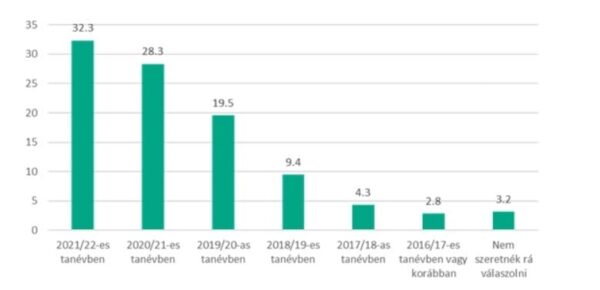
Figure 1. When did you start your university studies? % (n = 1704)

A third of the respondents were studying economics, but the response rate was also high among students in engineering and IT (13.8 per cent for the former and 10.3 per cent for the latter). 

Nearly 92% of respondents are studying full-time, 82% with public scholarships. Most respondents are in bachelor’s degree programmes (74.3 per cent), but there were also respondents in undivided master’s degree programmes (10.3 per cent) and master’s degree programmes (7.7 per cent).

Why does a subject or course become a favourite? To learn to learn

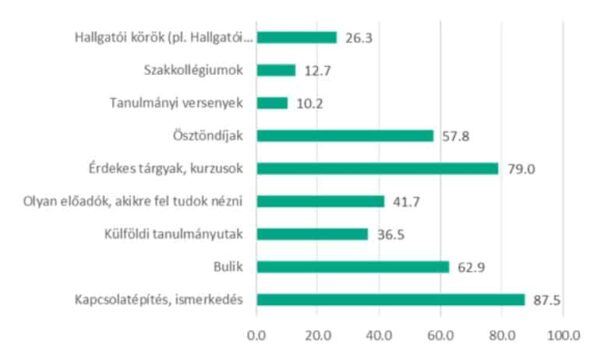
Our questionnaire also asked respondents what they like best about university life (Figure 2). Unsurprisingly, most respondents cited networking and getting to know other people – 87% of respondents think this is one of the greatest benefits of university life. Slightly behind this proportion, but compared to the rest, the opportunity to attend interesting courses and subjects during their university years is also important to many.
Respondents’ favourite subjects cover a very broad spectrum, but it is more interesting to look at why they consider a particular subject to be a favourite than to review these. The analysis of the responses shows that it is the practical orientation of the subjects and courses, as well as the preparedness of the teacher, the instructor and, in many cases, the personality of the teacher, that make a subject or course likeable. Of course, the importance of the students’ interests is also very evident. 

Where and how do you prefer to learn? The conditions of learning

With our questionnaire, we also wanted to find out what kind of environment and what kind of methods you prefer to learn in, or how you learn most effectively. The most popular learning environment turned out to be your own room (respondents think this is almost entirely true for them). 

This is significantly behind the library or a room on campus specifically designed for learning. The lowest rating was given to the dormitory study room – students even prefer to study in cafés and restaurants (at least according to our data) rather than in dormitory study rooms.

How much do you study per week?

We also looked at how much time fillers usually spend studying and preparing in a week. Most people (28 percent) spend 3-5 hours or 5-10 hours (26 percent) studying or preparing in a week, and about 16-16 percent spend less than 3 hours or 10-15 hours. Again, the proportion of people who study for more than 15 hours a week is the lowest (13 percent). This section also shows how the time spent studying varies by field of study.

What do you want after graduation? Programmes, jobs, career opportunities

Setting career goals is not easy. In the questionnaire, we have included questions to help you outline your ideas for the future. So we also tried to find out how you choose your path and what helps you make that choice. 

We asked you what kind of working conditions you would like to have after graduation – this is illustrated in Figure 2. Unsurprisingly, high pay was found to be the most motivating factor – 86 percent of respondents think so. In addition, the quality of the community, how „cool” colleagues are, and whether there are opportunities for career advancement also appear to be of outstanding importance. 
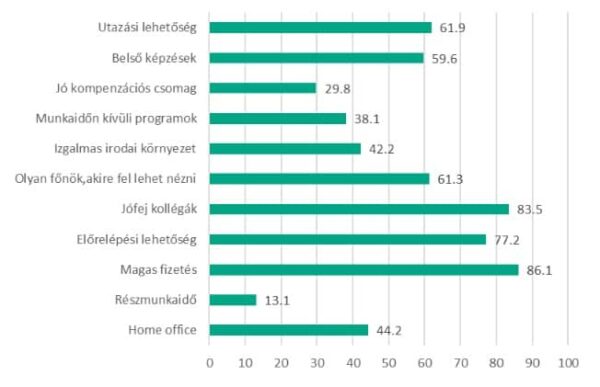
Medium factors include whether the employer provides travel opportunities, whether the boss is someone to look up to and whether internal training is provided. The possibility of part-time work and good compensation packages were less prominent in the responses.

Entrepreneurship as an opportunity!

We also asked respondents to what extent they feel that their studies have given them the skills they need in order to be able start and run a business. 

This question was answered by 870 respondents on a five-point scale, with an average of 2.68. However, there is a significant difference when looking at this question by field of study. Students/graduates in economics, law and agriculture are the most likely to feel that they have acquired the skills needed to start and run a business during their studies, while students/graduates in humanities, medicine and health and teacher education are the least likely to think so. 

How do you make a decision when you go to university?

In our questionnaire, we also wanted to find out what people choose to study at a higher education institution after secondary school. Young people make this decision mostly on the basis of information about the institution, but they also take into account the location of the university, the expected salary after graduation and their own academic performance. 

The advice of friends and teachers has the least influence on this decision. The information they need to make their decision is most often found on university websites, at open days or on the institutions’ social media platforms

42% of respondents said they found it difficult to prepare for their school-leaving exams. We also asked what they did to pass the exam and gain extra points: most (almost 69%) passed a language test, but there was also a high proportion of respondents who used an online platform to prepare (51%), went to a private tutor (49%) or attended a preparation course at school (42%).


Job hunt with a purpose

  • Decide what kind of job you would want exactly. Obviously, you might be interested in more than one career, but try to identify first the one that seems the most appealing to you.
  • Choose the company or place where you could see yourself working, or where you would like to work.
  • Study and examine the company where you would like to be employed in the future.
  • Establish exactly what qualifications and skills you will need for the coveted position.
  • Map your own skills, listing your strengths that would help you get the position, and identifying what you need to work on or acquire before you apply.
  • Plan how you are going to fill any skills gaps, and implement your plan as much as possible.
  • Prepare an ace application dossier, fine-tune your CV and everything else that is required for applying for the position.
  • Now is the time to apply. Be confident and well-prepared, safe in the knowledge that you have done everything for a successful application.

Tips for finding your place in your first job

Do:

  1. Be friendly

Even if office chat is not your thing (you are not the only one!), it does make sense in the long run to have a friendly relationship with the others you keep bumping into in the kitchen or by the coffee machine. This might include sharing snacks occasionally, wishing them a happy birthday, or helping them with a task, just because you are a nice person.

  1. Arrive early

Believe us, you will not be seen as an eager beaver if you arrive ten minutes early. On the contrary, it helps to start your day in calm, giving you the time to think over the tasks ahead. Not only will you look more focused to your colleagues, you probably will be.

  1. Be open and flexible

Whether you need to do something that is normally not your task, or start work earlier, it does help if you keep a flexible approach. It certainly will be to your credit if colleagues see that you are hard working.  

Don’t:

  1. Open up from day one

Having friends at work and enjoying the company is fine, but don’t attract undue attention by dishing out your private life in the office.

  1. Be a nuisance

When you are at your desk, don’t use the phone for private matters. It distracts others from their work, and nobody is interested to know when you are going for that check-up.

  1. Spam

If you hit ‘Reply all’ on an email addressed to hundreds of people, instead of just ‘Replying’ to the sender, that in itself is no big deal. When thirty people make the same mistake, it becomes a real nuisance. Try to be among those who can tell the difference between the two buttons.