chemistry – Diplomátszerzek

The European Patent Office illustrates its report on women inventors with Katalin Karikó

A comprehensive report on the women’s participation in inventive activity has been published by the European Patent Office (EPO), which analyzed patent applications submitted between 1978 and 2019 in the 38 countries contracting states to the European Patent Convention.

The report shows that the share of women inventors has increased steadily over time but is still far below parity with men inventors.

[kiemelt]In the late 1970s, the proportion of women inventors was only around 2 per cent, but in 2019 it had risen to 13.2 per cent.[/kiemelt]

The 2019 figure for Europe is well above the Japanese data (9.5 per cent), but below the US (15 per cent). China and South Korea have much higher shares of women inventors in 2019 (26.8 and 28.3 per cent, respectively), although EPO notes that the estimates are less robust than for other countries.

Hungary in the middle of the European ranking

Looking at the data from 2010 to 2019 for the 38 contracting states to the European Patent Convention, Latvia has the highest proportion of women inventors (30.6 percent).

The Baltic country is followed by Portugal and Croatia (26.8 and 25.8 per cent, respectively). Hungary is at the bottom of the midfield with 12.4 per cent. It is interesting to note that the same rates were also recorded in the UK and Denmark. Austria has the lowest proportion of women inventors (8 per cent), but Germany (10 per cent) is also among countries which stand at the bottom of the European ranking.

Biotechnology, pharmaceuticals: highest proportion of women inventors

The EPO report also shows that chemistry has the highest proportion of women inventors (22.4 per cent), according to the 2010-2019 pan-European data. Within the chemistry sector, biotechnology and pharmaceuticals have the highest proportion of women inventors (over 30 per cent). By contrast, the share of women inventors is only 7.3 and 5.2 per cent in electrical and mechanical engineering, respectively.

The EPO illustrates its report with Katalin Karikó (Photo: EPO)

Interestingly, the cover of the EPO’s report features Katalin Karikó, a world-renowned Hungarian biochemist who played a crucial role in the development of the mRNA vaccine used in the treatment of Covid. She graduated from the University of Szeged, started her career at the Szeged Biological Research Centre and after her lab lost its funding in 1985, continued her career in the US.

We recently reported the Hungarian team won three bronze medals at the European Girls’ Olympiad in Informatics (EGOI), a competition designed to encourage more women to choose a career in the ICT sector. Women currently make up around 15 per cent of students in higher education in the IT sector.

Natural sciences training

This article was published in the UNI 2022 summer edition.


Bachelor’s degree courses:

  •     biology
  •     biotechnology
  •     physics
  •     geography
  •     earth sciences
  •     chemistry
  •     environmental sciences
  •     mathematics

In the field of natural sciences, there are 8 bachelor’s degrees to choose from. Graduates can expect the highest average monthly gross salary in 

  • physics (HUF 408,000) and 
  • chemistry (HUF 361,000)

in the 2019 survey. Depending on their field of study, students can choose between several higher education institutions, including those in the capital and in rural areas.

Ranking of institutions

Average starting salary after graduation is taken as a ranking indicator.

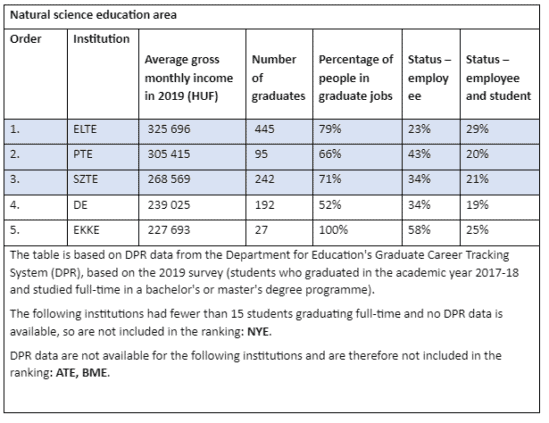
The average gross monthly income of science graduates in the 2017/18 academic year (based on 2019 data) is close to HUF 290,000, but there are differences between institutions. Looking only at full-time students, the highest salary was for graduates of ELTE, with a monthly gross salary of HUF 326,000. In terms of average gross monthly income, PTE is in second place with HUF 305 thousand, while SZTE is in third place with almost HUF 269,000. 

On average, 54 per cent of graduates with a bachelor’s degree in a field of study start working within 2.2 months of graduation. Nearly two thirds of graduates find a graduate job, the highest rates in the EKKE (100 per cent) and ELTE (79 per cent).

Around a quarter of graduates decide to continue their studies in employment after graduation, the highest rates in ELTE (29 per cent) and EKKE (25 per cent).

The top 3 universities

The average gross monthly income of ELTE graduates is HUF 326,000, which puts the institution at the top of our ranking of training areas in terms of the expected graduate salary after graduation. Within two months of graduation, graduates are already employed, with 79 per cent of them in graduate jobs. ELTE is the largest in the field of science (including in terms of the number of graduates), with 445 graduates in 2017-18. On average, ELTE students complete their bachelor’s degree in 7.7 active semesters.

The average gross monthly income of PTE graduates is HUF 305,000, which puts the university in second place in the ranking of training areas. On average, graduates are employed within 2.3 months of graduation, with 66 per cent of them finding a graduate job. 

The average gross monthly income of SZTE graduates is close to HUF 269,000, making the institution the third best in its field. Graduates are in employment within about 2.2 months after graduation, and 71 per cent of them succeed in finding a graduate job. In the field of natural sciences, SZTE is one of the larger institutions, with 242 graduates in the 2017-18 academic year.

Labour market situation of science graduates

A low proportion of graduates with a bachelor’s degree in science, only 4 per cent, studied abroad (e.g. under Erasmus) during their studies. During their training (before graduation), around 40 per cent of students had a professional job and around 60 per cent a nonprofessional job. 

After graduation, around 37 per cent of graduates settle and/or continue their studies in Budapest or County Pest . After completing their bachelor’s degree, they typically find employment in the private sector (72 per cent of graduates), 22 per cent in the public sector and around 6 per cent in non-profit or other employment. 

The proportion of graduates in the field who are employed in the labour market is high (87 per cent). Overall, graduates in science are satisfied with their jobs (67 per cent), but this is lower than in other fields.