degree – Diplomátszerzek

Shocking university superstitions! Do you know the famous and astonishing customs and beliefs of Hungarian universities?

The most common superstition, which applies to everyone

It is a common belief in almost all Hungarian universities that if you don’t have a number in your Neptune code, you will definitely fail your studies. 

Strange animal love BME style

The students of the Faculty of Electrical Engineering and Informatics at Budapest University of Technology and Economics have been keeping a special tradition for decades.

[kiemelt]As part of the Graduation Week, they visit the Buda Castle district, including the statue of András Hadik on horseback, to have the horse’s testicles cleaned, removing the outer layer of iron oxide.[/kiemelt] 

A common belief in almost all Hungarian universities says that if you don’t have a number in your Neptune code, you will definitely fail your studies. (Photo: 123rf)

The statue was once guarded by police, but that didn’t deter the students. A small delegation was reportedly sent in advance to distract the police so that the real team could gain access to the monument.

This custom is also very much alive and followed in high school circles. In many high schools in Budapest, the key to successful graduation is to go up, even if not to clean, but at least to pet the horse’s testicles before the exams.

Fashion problems with SOTE sweaters and pharmacist predictions

Even an institution as serious as Semmelweis University (SOTE) is not free of myths either. Supposedly, if you buy a SOTE sweater in your first few years, you will also be without a degree. 

But of course, there are many more predictions in connection with the university. It is said, for example, that the first year will tell you who will become a pharmacist, and the second year will tell you when… It is known that the first two semesters are a clear indication of who the course is for, and the two semesters after that are extremely difficult, as there is a lot to study. But those who get this far never stop training.

The law of attraction is of no use here…

The superstition spread at the University of Public Service is that if you wear a uniform with a rank higher than your own, you will never actually achieve that rank in your life.

Szeged beach season: get in the water with your clothes on

In Szeged, dental and medical students take a bath in the Dugonics Square fountain in front of the university’s main building after their final exams, dressed in festive attire(!).

Just be careful where you step…

At the Széchenyi István University in Győr, a rumor has spread that whoever steps on the center stone of the cobbled circle in front of the entrance of Hegedűs Gyula Dormitory, will simply not get a diploma.


Degree without language exam – Parliament will soon vote on the final exemption

Parliament will hold its final vote on the amendment to the higher education law, one important element of which is the abolition of the language examination required for graduation, in the week starting 21 November, according to the Parliament’s agenda on its website.

The government’s intention to drop the language exam requirement was already mentioned by János Csák, Minister of Culture and Innovation in the summer. 

Photo: 123rf

There is no similar regulation elsewhere in the EU

Speaking in last week’s parliamentary debate on the amendment of the Higher Education Act, László György, State Secretary for Innovation, Higher Education, said that the bill „addresses a long-standing problem” by settling language examination requirements.

[kiemelt]”The compulsory language examination attached to the degree was a unique Hungarian regulation, there is no similar regulation elsewhere in the European Union,” he said.[/kiemelt]

He highlighted that under the new rules, higher education institutions will be able to decide on the acquisition and assessment of foreign language skills appropriate to the qualification. He stressed that there is no doubt that foreign language skills are necessary for a university graduate, but the government’s position is that the „mechanical attachment” of a degree to the intermediate language examination has not lived up to expectations.

According to the explanatory memorandum to the bill, „the language examination as an administrative requirement does not in itself provide sufficient foreign language skills to enable graduates to meet the requirements of the labour market, and it is therefore appropriate that higher education institutions – which analyse and study labour market trends – should have the competence to decide on the acquisition and measurement of foreign language skills appropriate to the qualification”.

You will not even need a language exam to start your doctoral studies

Under the amended law, the language examination requirement for the start of doctoral studies will be dropped and replaced by „language proficiency in accordance with the doctorate regulations”. 

You can also read our articles on language learning and language exams below:

It is not compulsory everywhere, but don’t try to get away with it: learn languages!

Learn languages at the university!

Don’t just talk, understand why and how!

Social sciences training

This article was published in the UNI 2022 summer edition.

Bachelor’s degree courses

  • philosophy, politics, economics
  • information technology librarianship
  • communication and media studies
  • cultural anthropology
  • major in international studies
  • political sciences
  • social work
  • social pedagogy
  • sociology

There are 9 bachelor’s degrees in social sciences. The highest average monthly gross salary is in

  • international studies (HUF 345,000) and 
  • political sciences (HUF 337,000)

in the 2019 survey. Depending on their field of study, students can choose between several higher education institutions, including those in the capital and in rural areas.

Ranking of institutions

Average starting salary after graduation is taken as a ranking indicator.

The average gross monthly income of social science graduates in the 2017/18 academic year (based on 2019 data) is close to HUF 287,000, but there are significant differences between institutions. Only for full-time students, the highest salaries were paid to graduates of SZE, with a monthly salary of more than HUF 328,000. In terms of average gross monthly income, Corvinus is in second place with slightly more than HUF 313,000, while KRE is in third place with almost HUF 313,000. 

On average, 70 % of graduates with a bachelor’s degree in a field of study start working within 1.9 months of graduation. 68% of graduates find a graduate job, the highest rate among graduates from PTE (81%) and PPKE (80).

Around 21% of graduates decide to continue their studies after graduation while working, the highest rates being found in SZTE (27%) and Corvinus (26).

The top university

The average gross monthly income of graduates from SZE is nearly HUF 328,000, which puts the institution at the top of our ranking of training areas in terms of the expected graduate salary after graduation. A high proportion (73%) of graduates go on to graduate employment after graduation.

The average gross monthly income of Corvinus graduates is more than HUF 313,000, placing the university in second place in the ranking of training areas. Around two thirds of graduates find a graduate job after graduation. Corvinus is among the larger institutions in the social sciences field, with 294 graduates in 2017-18. Corvinus students complete an average of 6.3 active semesters of undergraduate studies in the social sciences.

The average gross monthly income of graduates of KRE is almost the same as that of Corvinus, at nearly HUF 313,000, which puts the institution in third place in the ranking of training areas. After graduation, 57% of graduates find a job as a graduate. On average, KRE students complete their bachelor’s degree in social sciences in 6.1 active semesters (KRE has the lowest average of our ranking).

Labour market situation of graduates in social sciences

A high proportion of graduates with a bachelor’s degree in social sciences, almost 10%, have studied abroad (e.g. under Erasmus) during their studies. During their training (before graduation), about half of the students had a professional job and 67% a non-professional job. 

After graduation, around 53% of graduates settle and/or continue their studies in Budapest or County Pest. After completing their initial training, they tend to find employment in the private sector (67% of graduates), 21% in the public sector and around 12% in non-profit or other employment. 

A high proportion of graduates in the field are employed in the labour market (87%). Overall, graduates in social sciences are satisfied with their jobs (87%).


Sports science training

This article was published in the UNI 2022 summer edition.

Bachelor’s degree courses:

  • coaching 
  • recreation and lifestyle
  • sports management

In the field of sports science, there are 3 bachelor’s degrees to choose from. The highest average monthly gross salary in terms of average monthly gross income is in

  • sports management course (HUF 287,000) and 
  • recreation management and health promotion (HUF 248,000)

in the 2019 survey. Depending on the subject, those interested in the field of study can choose between several higher education institutions, including those in the capital and in rural areas.

Ranking of institutions

Average starting salary after graduation is taken as a ranking indicator.

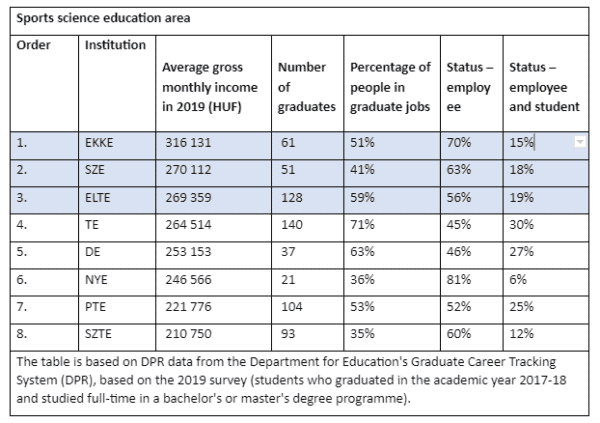
The average gross monthly income of sports science graduates in the 2017/18 academic year (based on 2019 data) is close to HUF 256,000, but there are significant differences between institutions. For full-time students only, the highest salaries were those of EKKE graduates, with a monthly gross salary of more than HUF 316,000. In terms of average gross monthly income, SZE is in second place with HUF 270,000, while ELTE is in third place with HUF 269,000. 

On average, 76% of graduates with a bachelor’s degree in a field of study start working within 1.9 months of graduation. 53% of graduates find a graduate job, the highest proportion among graduates from TE (71%) and DE (63%).

Around 20% of graduates choose to continue their studies in employment after graduation, the highest proportion among TE (30%) and DE (27%) graduates.

Top 3 universities

The average gross monthly income of EKKE graduates is close to HUF 316,000, which puts the institution at the top of our education area rankings for post-graduate earnings. Graduates are in employment in a little less than two months after graduation, but the proportion of graduates in employment is low (51%) compared to other fields of study. On average, EKKE students complete their bachelor’s degree in more than 8 active semesters.

The average gross monthly income of graduates from SZE is close to HUF 270,000, putting the university in second place in the ranking of training areas. After graduation, graduates are already employed in a little less than two months, with 41% of graduates in graduate jobs. On average, graduates from SZE complete their bachelor’s degree in almost 7 active semesters.

The average gross monthly income of ELTE graduates is close to HUF 269,000, putting the institution in third place in the ranking of education areas. Graduates are in employment within about 1.7 months after graduation, with 59% of them in graduate jobs. In the field of sports science, ELTE is one of the larger institutions, with 128 graduates in 2017-18.

The labour market situation of graduates in sports science

A high proportion of sport science graduates with a bachelor’s degree, nearly 10%, have studied abroad (e.g. under Erasmus) during their studies. During the training (before graduation), about half of the students had a professional job and 71% a nonprofessional job. 

After graduation, around 29% of graduates settle and/or continue their studies in Budapest or County Pest. After completing their initial training, they typically find employment in the private sector (67% of graduates), 12% in the public sector and around 21% in non-profit or other employment. 

There is a high proportion of graduates in the field who are employed in the labour market (85%). Overall, graduates in sport science are satisfied with their jobs (67%), but this is lower than in many other fields.


Teacher training

This article was published in the UNI 2022 summer edition.

Bachelor’s degree courses

  • infant and toddler care
  • special needs education
  • specialist teaching profession
  • pre-school teacher
  • specialised teacher training
  • teaching profession

Unbranched Master’s degree

  • unbranched teacher training course

The teacher education programme offers 6 bachelor’s degrees and one master’s degree. The highest average monthly gross salary is in

  • unbranched teacher training (HUF 262,000) and 
  • specialist teaching profession (HUF 248,000)

in 2019. Depending on the subject, those interested in the field of training can choose between several higher education institutions, including those in the capital and in rural areas.

Ranking of institutions

Average starting salary after graduation is taken as a ranking indicator.

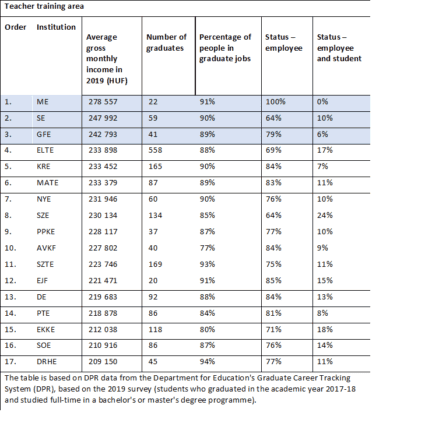
The average gross monthly income for teacher education graduates in the 2017/18 academic year (based on 2019 data) is around HUF 229,000, but there are differences between institutions. For full-time students only, the highest salaries were paid to ME graduates, who earned more than HUF 279,000 per month. In terms of average gross monthly income, SE came second with almost HUF 248,000, while GFE came third with HUF 243,000. 

88% of graduates with a bachelor’s degree in a field of study start working within 1.7 months of graduation on average. More than 88% of graduates find a graduate job.

14 % of graduates with bachelor’s degrees decide to continue their studies after graduation, the highest rates being found in the SZE (24 %), EKKE (18 %) and ELTE (17 %).

Top 3 universities

The average gross monthly income of ME graduates is close to HUF 279,000, which puts the institution at the top of our education area rankings for the expected graduate salary after graduation. The proportion of graduates in graduate jobs is high (91%) and it should be noted that ME graduates typically do not continue their studies after graduation.

The average gross monthly income of SE graduates is close to HUF 248,000, putting the university in second place in the ranking of education areas. SE also has a high proportion of graduates in graduate jobs (90%), but unlike ME, 10% of SE graduates choose to continue their studies even after they start working.

The average gross monthly income of GFE graduates is close to HUF 243,000, putting the institution in third place in the ranking of education areas. GFE students complete a bachelor’s degree in teacher education in an average of 6.7 active months. After graduation, 89% of graduates have a graduate job.

Labour market situation of graduates in teacher education

Only 7 % of teacher education graduates with a bachelor’s degree in teacher education have studied abroad (e.g. under Erasmus) during their training. During the training (before graduation), about half of the students had a professional job and 60% had a nonprofessional job. 

After graduation, a high proportion of graduates, around one third, settle and/or continue their studies in Budapest or County Pest. After completing their bachelor’s degree, also due to the nature of their studies, they tend to find a job in the public sector (68% of graduates), 16% in the private sector and around 16% in non-profit or other employment. The proportion of graduates in the field of education who are present in the labour market as employees is high (9%). Overall, graduates in teacher education are satisfied with their work (82%).

Medical and health sciences training

This article was published in the UNI 2022 summer edition.

Bachelor’s degree courses

  • nursing and patient care
  • digital dental planning
  • health care and prevention
  • health care organisation
  • medical diagnostic analysis

Unbranched Master’s degree

  • general medicine
  • dentistry
  • pharmaceutics

In the field of medicine and health sciences, there are 5 bachelor’s degrees and 3 master’s degrees. The highest average monthly gross salary in terms of gross monthly income is in

  • pharmaceutics (HUF 467,000) and 
  • general medicine (HUF 443,000)

however, it is important to note that these figures were compiled before the large-scale wage adjustment of state-employed doctors, and include data from both the public and the private sectors. Depending on their field of study, those interested in a particular field of training can choose between several higher education institutions, including those in the capital and in rural areas.

Ranking of institutions

Average starting salary after graduation is taken as a ranking indicator.

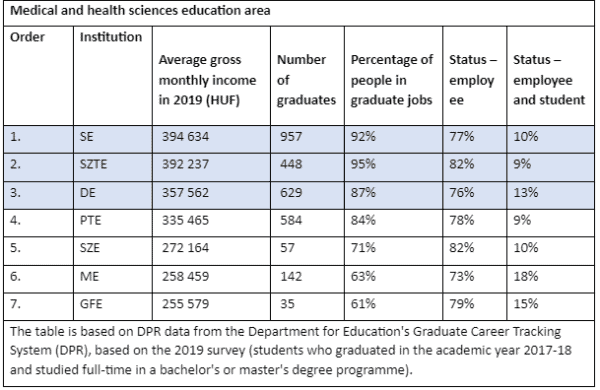
The average gross monthly income of medical and health science graduates in the 2017/18 academic year (based on 2019 data) is close to HUF 364,000, but there are significant differences between institutions. In terms of full-time graduates alone, the highest salaries were for SE graduates, with a monthly gross salary of more than HUF 395,000. In terms of average monthly gross starting salary, SZTE is in second place with nearly HUF 392,000, while DE is in third place with HUF 358,000.

On average, 87% of graduates with a bachelor’s degree in a field of study start working within 2 months after graduation. 82% of graduates manage to find a graduate job, the highest rate among graduates from SE, SZTE and PTE.

Around 13% of graduates choose to continue their studies in employment after graduation, the highest rates in ME (18%), GFE (15) and DE (13).

The top 3 universities

The average gross monthly income of SE graduates is close to HUF 395,000, which puts the institution at the top of our education area rankings for the expected graduate salary after graduation. A little less than two months after graduation, graduates are employed and 92% of them are in graduate jobs. SE is the largest training institution in the field of medicine and health sciences (including also the number of graduates), with 957 graduates in 2017-18. On average, SE students complete their undergraduate studies in more than eight active semesters.

The average gross monthly income of graduates from SZTE is nearly HUF 392,000, which puts the university in second place in the ranking of education areas. After graduation, graduates are employed in a little less than two months and 95% of them are in graduate jobs. SZTE is among the larger institutions in the field of medicine and health sciences, with 448 graduates in the 2017-18 academic year. Out of the seven institutions in our ranking, SZTE students complete their undergraduate studies in the fewest number of active semesters (8.1 semesters).

The average gross monthly income of DE graduates is nearly HUF 358 000, which puts the institution in third place in the ranking by education area. Graduates are employed within about two and a half months of graduation, and 87% of them are in graduate jobs. DE is also one of the larger training institutions in the field of medicine and health sciences, with 629 graduates in the 2017-18 academic year.

Labour market situation of graduates in medicine and health sciences

Only 4 % of graduates in basic medical and health sciences have studied abroad (e.g. under Erasmus) during their training. During training (before graduation), about half of the students had a professional job and almost 60% a nonprofessional one. 

After graduation, around 26% of graduates settle and/or continue their studies in Budapest or County Pest. After completing their bachelor’s degree, they tend to find employment in the public sector (56% of graduates), 33% in the private sector and around 11% in non-profit or other employment. The proportion of graduates in the field of training who are in the labour market as employees is high (90%). Overall, graduates in the field of medicine and health sciences are satisfied with their work (87%).


Technical training

This article was published in the UNI 2022 summer edition.

Bachelor’s degree courses:

  • materials engineering
  • bioengineering
  • safety engineering
  • biomedical engineering – safety engineering – energy engineering
  • architectural Engineering
  • civil engineering
  • wood engineering
  • mechanical engineering
  • industrial product and design engineering
  • vehicle operation engineering
  • automotive engineering
  • light industrial engineering
  • environmental engineering
  • transport engineering
  • logistics engineering
  • mechatronics engineering
  • molecular bionics engineering
  • technical earth sciences
  • engineering management
  • aeronautical engineering
  • test engineering
  • fire protection engineering
  • chemical engineering
  • electrical engineering
  • electrical engineering
  • water management engineering

Unbranched master’s degree

  • architecture

Within the technical field, there are 26 bachelor’s degrees and 1 master’s degree. The highest average monthly gross salary is in

  • automotive engineering (HUF 512,000) and
  • electrical engineering (HUF 492,000 )

based on 2019 data. Depending on the subject, those interested in the field of study can choose from several higher education institutions, including those in the capital and in rural areas.

Photo: 123RF

Institutional ranking

Average salary after graduation is taken as the ranking indicator.

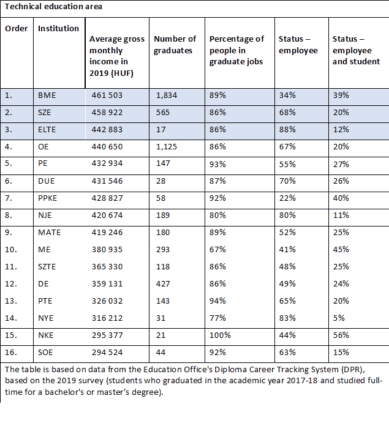
Average gross monthly income of technical graduates in the 2017/18 academic year (based on 2019 data) is close to HUF 428,000, but there are significant differences between institutions. Looking only at full-time students, the highest salaries were paid to BME graduates, who earned more than HUF 461,000 per month. In terms of average gross monthly income, SZE came second with nearly HUF 459,000, while ELTE came third with HUF 443,000. 

On average, 81% of graduates in a bachelor’s degree in a field of study start working within 1.6 months after graduation. 88% of them manage to find a graduate job, and four institutions (PE, PPKE, PTE, SOE) have a very high rate of over 90%, while all graduates of NKE have a graduate job. 

Around 31% of people in initial education and training decide to continue their studies after graduation. This is most common for graduates from NKE (56%), ME (45) and PPKE(40).

Top 3 universities 

The average gross monthly income of BME graduates is nearly HUF 462,000, putting the institution at the top of our ranking of education areas in terms of expected graduate salaries after graduation. A very high proportion of students (89%) go on to graduate work after graduation. In terms of student numbers, BME is the most significant point in the engineering field, with 1 834 students graduating in the period under review.

The average gross monthly income of graduates from SZE was HUF 459,000, putting the university in second place in the ranking of education areas. A very high proportion of graduates (72%) have a graduate job. On average, graduates are also in work within 1.1 months of graduation, with a very high proportion (86%) in graduate jobs.

The average gross monthly income of graduates from ELTE is close to HUF 443,000, putting the institution in third place in the ranking of education areas. After graduation, a high proportion of graduates (86%) have a graduate job. 

Labour market situation of graduates in technical education

A relatively high proportion of graduates with a bachelor’s degree in engineering have studied abroad (e.g. under Erasmus) during their studies: 6%. During the training (before graduation), 64% of students had a professional job and about the same proportion of students (67%) who (also) did a non-professional job. 

After graduation, graduates mainly find a job and/or continue their studies in Budapest (35%) or County Pest (11). After finishing their bachelor’s degree, 93% start working in the private sector, with only around 5% of graduates taking a job in the public sector and 2% in non-profit or other employment. The proportion of graduates in the field of education who are employed in the labour market is high (92%). Overall, graduates in technical education are generally satisfied with their jobs (83%).


Computer science training

This article was published in the UNI 2022 summer edition.

Bachelor’s degree courses

  • business Informatics
  • computer engineer
  • computer programming
  • industrial computer engineer

In the field of information technology, students can choose from 4 bachelor’s degree courses. In terms of average monthly gross earnings, the highest starting salary is in

  • IT engineer (HUF 521,000) and
  • computer programming (HUF 486,000)

based on 2019 data. Depending on the subject, those interested in the field of study can choose between several higher education institutions, including those in the capital and in rural areas.

Photo: 123RF

Ranking of institutions

Average starting salary after graduation is taken as a ranking indicator.

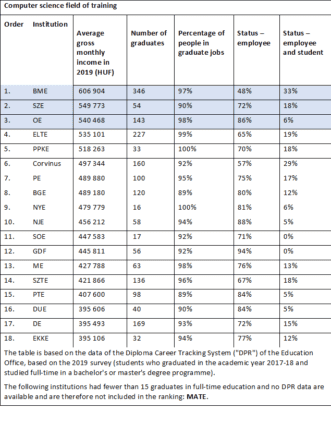
The average gross monthly income of graduates in the field of computer science in the 2017/18 academic year is close to HUF 488,000 based on 2019 data, and although there are significant differences between institutions, compared to other fields of study, graduates in computer science can expect a higher starting gross monthly income. For day students alone, the highest salaries were for BME graduates, who earned more than HUF 607 thousand per month. In terms of average gross monthly income, SZE was in second place with almost HUF 550 000, while OE came in third with HUF 540 000. 

86% of graduates with a bachelor’s degree in a field of study start working within 1.1 months of graduation, on average. A significant proportion (94%) succeed in finding a graduate job, with all but two universities having a rate of 90% or more. 

Around 13 % of those in initial training decide to continue their studies in employment after graduation. Further study is most common among graduates of BME (33 %) and Corvinus (29 %).

The top 3 universities

The average gross monthly income of BME graduates is more than HUF 607,000, putting the institution at the top of our ranking of training areas in terms of the expected graduate salary after graduation. Within a little less than a month after graduation, graduates are already in work, with a very high proportion (97%) in graduate jobs. In the field of computer science, the BME is one of the larger training institutions, with 347 graduates in the survey period. 

The average gross monthly income of graduates from SZE is HUF 550,000, putting the university in second place in the ranking of training areas. A very high proportion of graduates (90 %) have a graduate job. In terms of the number of months needed to get a first job, graduates from HEI top the list: they are usually in work within half a month of graduation.

The labour market situation of graduates in computer science

The share of graduates with a bachelor’s degree in computer science is not very high, with only 4% having studied abroad (e.g. under Erasmus) during their studies. However, more than two thirds of students have had a professional job during their training (before graduation) and a high proportion of students (63%) have (also) had a non-professional job before graduation.

After graduation, graduates are most likely to work and/or continue their studies in Budapest (35%) or Pest county (11%). After completing their bachelor’s degree, they are predominantly (94%) employed in the private sector, and only around 6 % of graduates take up a job in the public sector, in a non-profit or other type of employment. 

The proportion of graduates in the field who are present as employees in the labour market is high (89 %). Overall, graduates with a degree in computer science are generally satisfied with their jobs (81 %).

Legal training

This article was published in the UNI 2022 summer edition.

Bachelor’s degree courses

  • degree in judicial administration
  • Human Resources, Labour and Social Administration

Master’s Degree

  • Bachelor of Law

In the field of law, there are 2 bachelor’s degrees and only 1 master’s degree. The highest average monthly gross salary in terms of expected gross monthly income in 2019 is in

  • Bachelor of Law (HUF 307,000), and
  • Labour and Social Security Administration (HUF 281 000).

(Of course, salaries have increased since then, but our rankings still show the differences between institutions; we will update the figures as soon as we get fresh official data – editor.) Depending on their field of study, graduates can choose between several higher education institutions, including those in the capital and in rural areas.

Photo: 123RF

Ranking of institutions

The average salary after graduation is taken as a ranking indicator.


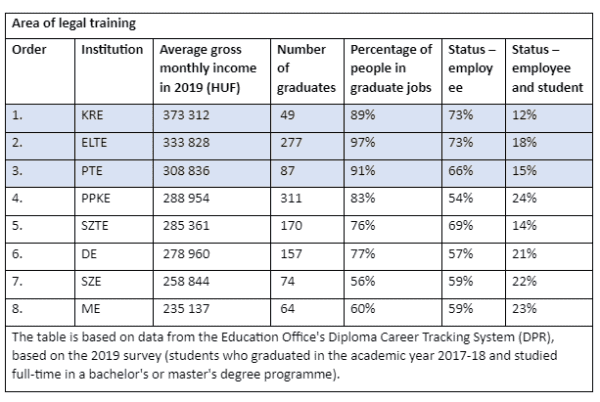
The average gross monthly income of law graduates in the 2017/18 academic year (based on 2019 data) is close to HUF 300,000, but there is a significant difference between institutions. For full-time students only, the highest salaries were those of KRE graduates, with a monthly salary of more than HUF 373,000. In terms of average gross monthly income, ELTE came second with almost 334,000 HUF, while PTE came third with 309,000 HUF. 

On average, 74% of graduates with a bachelor’s degree in a field of study start working within 2.5 months of graduation. Fifty-six per cent of them succeed in finding a graduate job – this is mostly the case for former students from the top three institutions in our ranking. Around a quarter of those in initial training decide to continue their studies even when employed after graduation.

The top 3 universities

The average gross monthly income of graduates from KRE was nearly HUF 373,000, putting the institution at the top of our ranking of training areas in terms of the expected graduate salary after graduation. A very high proportion (89%) of graduates go on to graduate employment after graduation. In the field of law, KRE is not one of the larger training institutions in terms of the number of graduates, with 49 graduates in the period under review. 

The average gross monthly income of ELTE graduates was 334 thousand forints, slightly below the top ranked institution, placing the university in second place in the ranking of training areas. Of the institutions in our list for the legal field, ELTE graduates have the highest proportion (97%) of graduate jobs. In terms of the number of graduates in the period under review, ELTE is the second largest training institution, with 277 graduates in the 2017/18 academic year.

The average gross monthly income of graduates from PTE was nearly HUF 309,000, placing it third in the ranking of training areas. After graduation, a high proportion of graduates (91%) go on to graduate jobs. 

Labour market situation of law graduates

Just under 2 % of law graduates have studied abroad (e.g. through Erasmus) during their studies, although this low proportion is mainly due to the specificities of the field. Almost half of the students have had a professional job during their studies (before graduation), and a similar proportion (55 %) have (also) had a non-professional job before graduation.

After graduation, the graduates in the survey were most likely to have found a job and/or continued their studies in County Hajdú-Bihar (14%), Budapest (13%) or County Borsod-Abaúj-Zemplén (11%). After their initial training, around 60% of recent graduates start working in the private sector and 35% in the public sector, while only around 5% of graduates take a job in a non-profit employer. 

The proportion of graduates in the field of education who are present as employees in the labour market is high (85%). Overall, graduates in the field of law are generally dissatisfied with their jobs (75%).


The starting salaries you can expect with a degree from an English top university

The University Admission Centre UK (UACUK), one of the top London-based student university admission consultants, ranked the starting salaries for UK graduates, based on last year’s figures.

The UACUK found that graduates from Imperial College London (ICL) have the highest starting salary on average (£33,500 per year).

Oxford is behind Cambridge by just £100

The London School of Economics came second in the ranking with an annual salary of £32,000, and Cambridge University third with £30,100. Oxford University is behind by just £100 a year its big rival, Cambridge. We recently reported that Oxford has gained the top spot in The Times university list for the first time in 12 years.

Graduates from University College London attend their graduation ceremony in Central London (Photo: 123rf)

The median salaries shown in the survey reflect the average starting salaries of all graduates at a given university. The starting salaries of graduates with a given subject can vary significantly depending on which university the student graduated from. For example, Computer Science graduates from Oxford University have median wages of £65,000, while graduates with the similar course from Leeds Beckett University could earn £20,000.

Starting salary for graduates (£, 2021, per year, median):

  • 1. Imperial College: 33,500
  • 2. London School of Economics: 32,000
  • 3. Cambridge University: 30,100
  • 4. University College London: 30,000
  • 4. Oxford University: 30,000
  • 6. King’s College London: 29,000
  • 6. St George’s University of London: 29,000
  • 6. Warwick University: 29,000
  • 9. Bath University: 28,500
  • 10. Bristol University: 28,000
  • 10. Queen Mary University of London: 28,000