egoi – Diplomátszerzek

Magyar sikerek az európai lány informatikai diákolimpián

Mind a négy magyar induló dobogóra állhatott a világ egyik legnívósabb lány informatikai versenyén, az Európai Lány Informatikai Diákolimpián (EGOI). A nemzetközi mezőnyben elért eredmény újabb bizonyítéka annak, hogy a lányoknak is helyük van az informatikában – és hogy Magyarország ezen a téren is az élvonalba tartozik.

Két arany, két ezüst: kiemelkedő magyar szereplés

A bonni versenyen 60 ország közel 230 diákja mérte össze tudását – és a magyar csapat valamennyi tagja éremmel térhetett haza. Aranyérmes lett Keresztély Zsófia (Szent István Gimnázium, Budapest) és Horváth Dóra (Baksa Kálmán Két Tanítási Nyelvű Gimnázium, Győr), míg Baran Júlia (Fazekas Mihály Gimnázium, Debrecen) és Varga Vivien (Radnóti Miklós Kísérleti Gimnázium, Szeged) ezüstérmet szerzett.
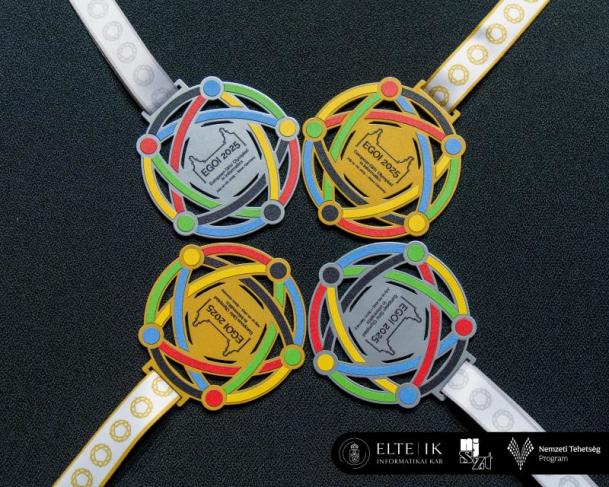
Mind a négy magyar középiskolás induló érmet szerzett az idén Bonnban megrendezett nemzetközi versenyen.

Nem csak Európából érkeztek

Noha az EGOI „európai” jelzőt visel, a verseny évről évre egyre nemzetközibbé válik. Idén az Egyesült Államoktól Ausztráliáig 53 ország versenyzői vettek részt személyesen a németországi megmérettetésen. További hét ország – például Malajzia és Algéria – online kapcsolódott be.

Komoly felkészülés, erős háttértámogatás

A magyar csapat az ELTE Informatikai Karának szakmai felkészítésében és a Neumann Társaság tehetséggondozási programján keresztül készült fel a versenyre, a Nemzeti Tehetség Program 1823 támogatásával. A csapatot Erdősné dr. Németh Ágnes és Tóth Tekla vezették, mindketten az ELTE Informatikai Karának adjunktusai.

Példamutatás és sztereotípiák lebontása

„A magyar lányok az idei évben szerepeltek az eddigi legkiemelkedőbb teljesítménnyel, miközben lehetőségük volt megismerkedni más lányokkal a világ minden tájáról és inspirálódni az ő történeteikből, ami valahol éppen ugyanaz: megtalálni a helyünket a világban és élni a lehetőségeinkkel legjobb tudásunk szerint. Ez a befogadó közeg inspiráló lehet számukra a további tanulmányaik és munkájuk során is. Reméljük, hogy az idei siker hozzájárul majd ahhoz, hogy több nő válasszon pályát az informatikai területen, és visszaszoruljon az a téves sztereotípia, miszerint az informatika férfias szakma” – kommentálta az idei eredményeket Erdősné dr. Németh Ágnes, a Neumann Társaság Tehetséggondozási Szakosztályának elnöke.

Az EGOI 2025 részletes eredménylistája a verseny hivatalos honlapján olvasható.

Kiemelt kép: ELTE
Three Hungarian bronze medals at the European Girls’ Olympiad in Informatics

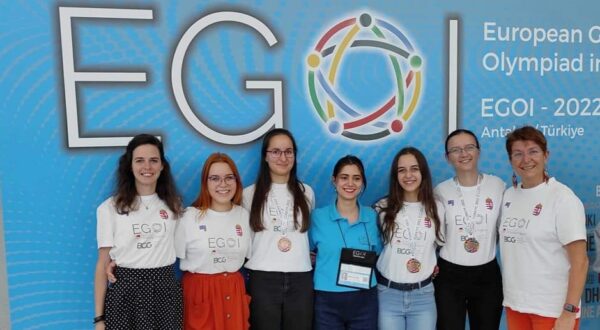
This year, the European Girls’ Olympiad in Informatics (EGOI) was held for the second time, where the competitors had to solve competitive programming tasks. Three of the four members of the Hungarian team won bronze medals at the competition in Antalya, Turkey (their school and specific placement in brackets):

  • Júlia Éles (ELTE Faculty of Informatics, 28th place)
  • Korina Nagy (Bányai Júlia High School, Kecskemét, 30th place)
  • Csilla Fülöp (Radnóti Miklós High School, Szeged, 32nd place).

Zsanett Szabó (vice head of the team), Boglárka Nagy, Csilla Fülöp, Merve Nasli guide, Korina Nagy, Júlia Éles and dr. Ágnes Németh (head of the team) (Photo: Facebook site of the John von Neumann Computer Society)

The fourth member of the Hungarian team, Boglárka Nagy from Kölcsey Ferenc Main High School in Satu Mare, Romania, also scored well, finishing in the middle of the field in 50th place in the competition, which was attended by around 100 secondary school students from 44 countries.

John von Neumann Computer Society prepared the students

The Hungarian student Olympians prepared for the competition under the John von Neumann Computer Society (NJSZT) Talent Management Program, with the support of the National Talent Program and the strategic management consultancy Boston Consulting Group. The latter company offered the highest scoring Hungarian contestant, Julia Éles, a visiting associate position as a special prize, which she can complete after her second year at the university.

Júlia Éles won the silver medal in the first edition of the competition last year, when she was a student at the Kölcsey Ferenc Main High School in Satu Mare. „The possibility of creation is what attracted me most to computer science: you can create something from an empty file with just a few lines of code. For me, that’s the beauty of computer science,” the student from ELTE’s Faculty of Computer Science told the ELTE website.

Few women work as computer scientists

In its report on this year’s competition, the NJSZT stressed that the EGOI was organised to encourage young girls to get involved in computer science, as there are fewer women than necessary working as computer scientists, both in the world and in Hungary. „Experience shows that many girls do not choose a career in the ICT sector because decades-old stereotypes still lead many to believe that it is a masculine profession, but wrongly so,” said NJSZT.

According to KSH data, in the academic year 2021/22, a total of about 22,000 students were studying IT in higher education (bachelor and master) in Hungary, of which about 3,400 were female students, which corresponds to a 15 percent share.

Recently, we reported that the Pro Progressio Foundation, which is affiliated to the Budapest University of Technology and Economics (BME), has established an award for secondary school teachers named after the first Hungarian female engineer, Eszter Pécsi. The aim of the prize is to prepare as many secondary school girls as possible for careers in engineering and natural sciences.

We also reported on another Hungarian student success recently: in the web development category, BME student Botond Sisák was awarded the silver medal at the World Skills Competition.