The Innovation Cooperation Agreement was signed on 18 October at Corvinus University by Rector Előd Takáts on behalf of Corvinus, Rector András Gelencsér on behalf of the University of Pannonia and President Zoltán Birkner on behalf of the National Research, Development and Innovation Office.
„The collaboration is an excellent example of how to effectively exploit the synergies existing in Hungarian innovation science workshops and share our results with the public and economic actors. Corvinus also offers two types of professional training in this field – the Research and Innovation Manager and the Professional Economist programs – and we will incorporate the experience gained through this cooperation into their development,” said Előd Takáts, Rector of Corvinus.
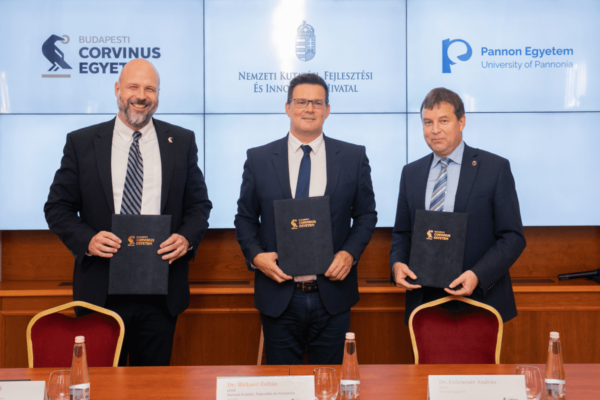
The agreement was signed by Rector Előd Takáts (Corvinus), President Zoltán Birkner (National Research, Development and Innovation Office) and Rector András Gelencsér (University of Pannonia). Photo: Corvinus
„In a world of emergencies and crises, it is particularly important to exploit the results of innovation in different professional fields as quickly and as extensively as possible, and to create a dialogue between the various sectors and society. The biggest obstacle to the exploitation of innovation products is habituation and lack of knowledge, which is as challenging to overcome as the development of the innovation idea itself. We expect that our cooperation will provide indispensable support for the former process,” said András Gelencsér, Rector of the University of Pannonia.
Zoltán Birkner, President of the NRDIH, highlighted: „We are on the right track, with knowledge-producing universities and research institutes, as well as businesses, becoming more and more aware of this. The success of university-level innovation training is no coincidence, as the demand for experts who can see through innovation processes and manage them on a day-to-day basis has been growing steadily in recent years.”
With the agreement, the signatory institutions are bringing together their intellectual and scientific capacities in order to communicate, promote and raise the profile of the scientific results of innovation management in Hungary and internationally to the interested and involved public. As part of this effort, they will seek to establish professional research, programs, publications and collaborations in the discipline, and to develop related training.
In order to share and promote the scientific and professional results of national and international innovation, the collaborating organisations will
[kiemelt]establish the National Innovation Conference, with the common determination to develop it into an international event.[/kiemelt]
The aim of the conference is to create an opportunity for a common and diverse reflection on innovation and the transfer of innovation-related professional knowledge, thus contributing to a more successful and competitive domestic entrepreneurial sector and a more developed and flourishing innovation socio-economic environment. Corvinus and the University of Pannonia will alternate hosting the conference each year, with Corvinus hosting the conference in November 2022. The forerunner of the event was organised by the University of Pannonia last year.