PTE – Diplomátszerzek

The University of Pécs setting up a science and innovation park

The investment will be made by rebuilding and modernising two former hospital building. The two buildings will provide a total of 2,600 sqm space for seven research teams, MTI reported.

Increased cooperation with the business sector

The aim of the investment is to „intensify cooperation between PTE and the business sector, i.e. to jointly create innovations and marketable products”, vice rector József Betlehem told the PTE website in September.

At a recent press conference held at the university, it was pointed out that the location of the PTE Nyár Street site connects the different disciplines, making it an excellent base for bringing together the developments already underway and those to come.
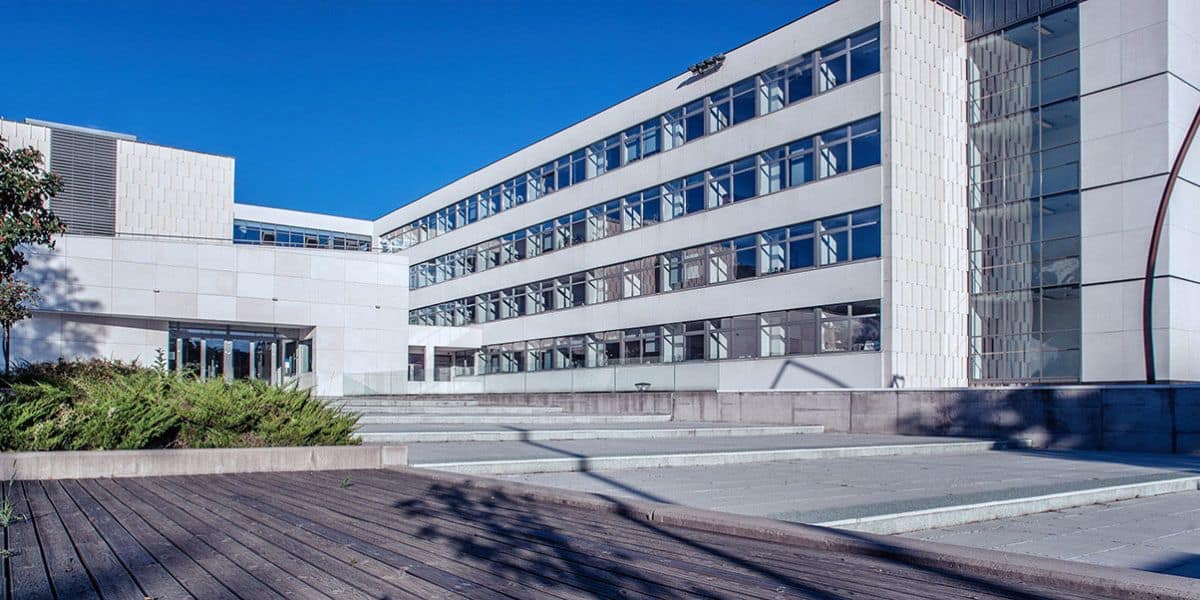
PTE Faculty of Engineering and Information Technology. Some parts of the Science and Innovation Park will be built on the faculty’s site (Photo: PTE)

The Centre for Digital Data Analysis and Laboratory will move to the main building with several research groups. Research groups working on health and economic data analysis, secondary raw material and hydrogen technology exploitation, and research and development on smart health applications and processes will be co-located in this building, according to PTE press release.

Seven research teams will occupy the park in 2024

The former pulmonology building will be converted into the Knowledge Management Centre, which will provide the capacities and processes for the flow of university knowledge to industry and for the transfer of knowledge from industry to researchers, teachers and students.

[kiemelt]Construction started in November 2022 and is expected to be completed in autumn 2023.[/kiemelt]

Parallel to the construction works, the procurement of furniture, IT equipment and research tools needed to make the buildings functional is ongoing. The 7 research teams are expected to occupy the completed Science and Innovation Park in 2024.

Hungarian universities became members of the International Association of Science Parks

In October we reported that Óbuda University and University of Sopron are the first Hungarian higher education institutions which became a member of the International Association of Science Parks and Areas of Innovation (IASP). Besides the two universities, one more Hungarian entity, the Sport Life Science Park, founded by the Foundation for University of Physical Education, has also joined IASP.

Natural sciences training

This article was published in the UNI 2022 summer edition.


Bachelor’s degree courses:

  •     biology
  •     biotechnology
  •     physics
  •     geography
  •     earth sciences
  •     chemistry
  •     environmental sciences
  •     mathematics

In the field of natural sciences, there are 8 bachelor’s degrees to choose from. Graduates can expect the highest average monthly gross salary in 

  • physics (HUF 408,000) and 
  • chemistry (HUF 361,000)

in the 2019 survey. Depending on their field of study, students can choose between several higher education institutions, including those in the capital and in rural areas.

Ranking of institutions

Average starting salary after graduation is taken as a ranking indicator.

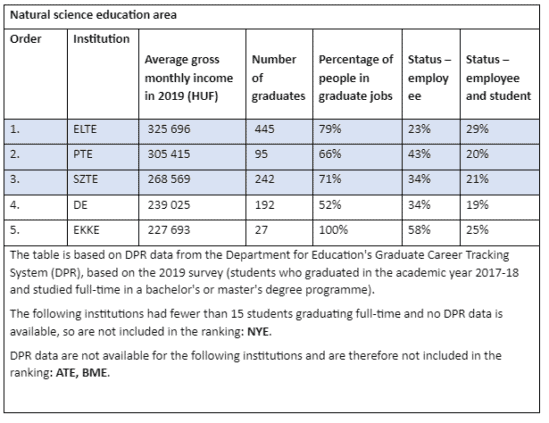
The average gross monthly income of science graduates in the 2017/18 academic year (based on 2019 data) is close to HUF 290,000, but there are differences between institutions. Looking only at full-time students, the highest salary was for graduates of ELTE, with a monthly gross salary of HUF 326,000. In terms of average gross monthly income, PTE is in second place with HUF 305 thousand, while SZTE is in third place with almost HUF 269,000. 

On average, 54 per cent of graduates with a bachelor’s degree in a field of study start working within 2.2 months of graduation. Nearly two thirds of graduates find a graduate job, the highest rates in the EKKE (100 per cent) and ELTE (79 per cent).

Around a quarter of graduates decide to continue their studies in employment after graduation, the highest rates in ELTE (29 per cent) and EKKE (25 per cent).

The top 3 universities

The average gross monthly income of ELTE graduates is HUF 326,000, which puts the institution at the top of our ranking of training areas in terms of the expected graduate salary after graduation. Within two months of graduation, graduates are already employed, with 79 per cent of them in graduate jobs. ELTE is the largest in the field of science (including in terms of the number of graduates), with 445 graduates in 2017-18. On average, ELTE students complete their bachelor’s degree in 7.7 active semesters.

The average gross monthly income of PTE graduates is HUF 305,000, which puts the university in second place in the ranking of training areas. On average, graduates are employed within 2.3 months of graduation, with 66 per cent of them finding a graduate job. 

The average gross monthly income of SZTE graduates is close to HUF 269,000, making the institution the third best in its field. Graduates are in employment within about 2.2 months after graduation, and 71 per cent of them succeed in finding a graduate job. In the field of natural sciences, SZTE is one of the larger institutions, with 242 graduates in the 2017-18 academic year.

Labour market situation of science graduates

A low proportion of graduates with a bachelor’s degree in science, only 4 per cent, studied abroad (e.g. under Erasmus) during their studies. During their training (before graduation), around 40 per cent of students had a professional job and around 60 per cent a nonprofessional job. 

After graduation, around 37 per cent of graduates settle and/or continue their studies in Budapest or County Pest . After completing their bachelor’s degree, they typically find employment in the private sector (72 per cent of graduates), 22 per cent in the public sector and around 6 per cent in non-profit or other employment. 

The proportion of graduates in the field who are employed in the labour market is high (87 per cent). Overall, graduates in science are satisfied with their jobs (67 per cent), but this is lower than in other fields.