The University of Pécs setting up a science and innovation park
The investment will be made by rebuilding and modernising two former hospital building. The two buildings will provide a total of 2,600 sqm space for seven research teams, MTI reported.
Increased cooperation with the business sector
The aim of the investment is to „intensify cooperation between PTE and the business sector, i.e. to jointly create innovations and marketable products”, vice rector József Betlehem told the PTE website in September.
At a recent press conference held at the university, it was pointed out that the location of the PTE Nyár Street site connects the different disciplines, making it an excellent base for bringing together the developments already underway and those to come.
PTE Faculty of Engineering and Information Technology. Some parts of the Science and Innovation Park will be built on the faculty’s site (Photo: PTE)
The Centre for Digital Data Analysis and Laboratory will move to the main building with several research groups. Research groups working on health and economic data analysis, secondary raw material and hydrogen technology exploitation, and research and development on smart health applications and processes will be co-located in this building, according to PTE press release.
Seven research teams will occupy the park in 2024
The former pulmonology building will be converted into the Knowledge Management Centre, which will provide the capacities and processes for the flow of university knowledge to industry and for the transfer of knowledge from industry to researchers, teachers and students.
[kiemelt]Construction started in November 2022 and is expected to be completed in autumn 2023.[/kiemelt]
Parallel to the construction works, the procurement of furniture, IT equipment and research tools needed to make the buildings functional is ongoing. The 7 research teams are expected to occupy the completed Science and Innovation Park in 2024.
Hungarian universities became members of the International Association of Science Parks
In October we reported that Óbuda University and University of Sopron are the first Hungarian higher education institutions which became a member of the International Association of Science Parks and Areas of Innovation (IASP). Besides the two universities, one more Hungarian entity, the Sport Life Science Park, founded by the Foundation for University of Physical Education, has also joined IASP.
Foreign language libraries in Budapest
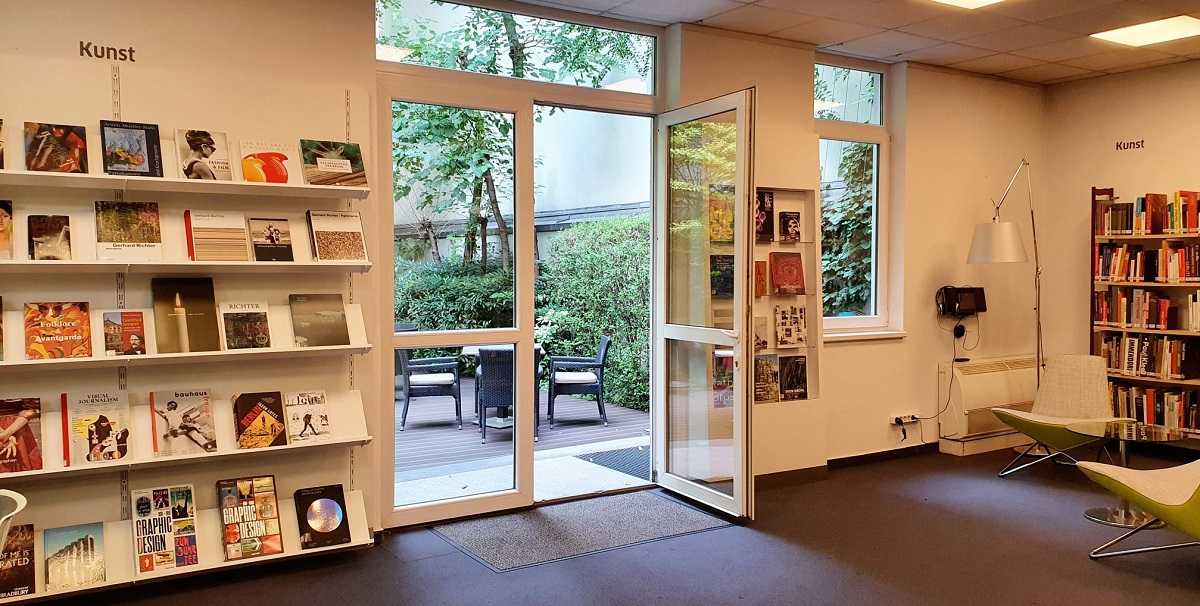
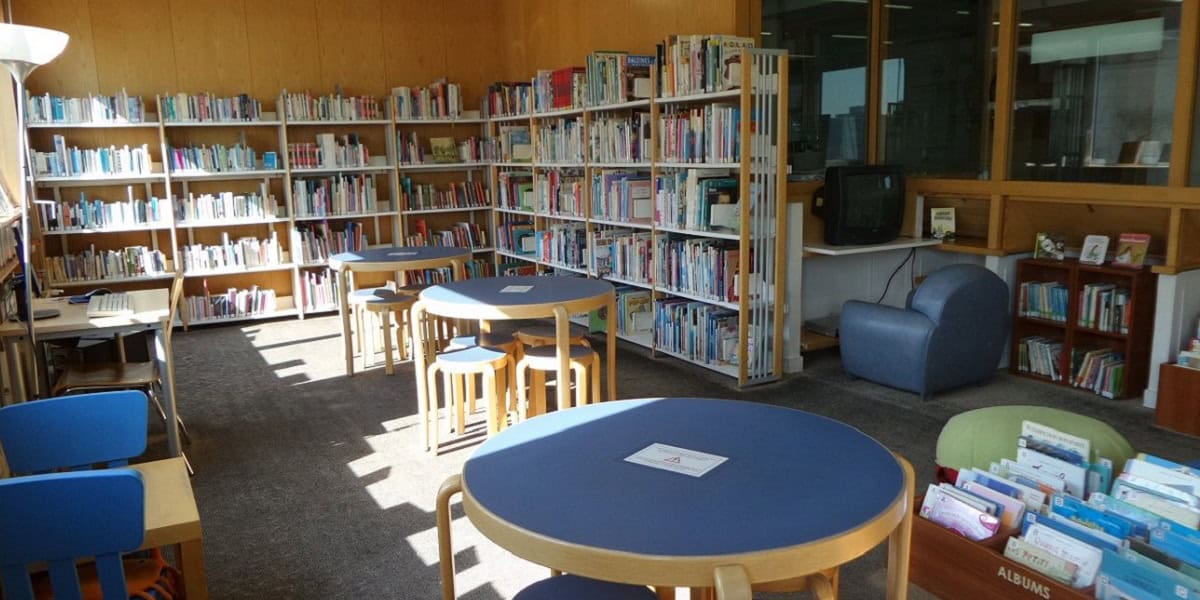
For a thorough thesis or a more detailed study, it’s essential to have the right, credible and even relevant sources, so it’s a good idea to have an overview of which libraries to choose from, and which documents you can find digitally and which ones only on the spot.
It is also important to know that librarians can help you a lot with your research, so don’t be afraid to approach them, after all that’s why they are there! And if you just need a quiet and cozy place to study, or perhaps you would like to read between classes, these quiet book kingdoms are still a great option.
National Library of Foreign Literature
National Library of Foreign Literature (Photo: Facebook)
The National Library of Foreign Literature and Music Collection is a public library in Budapest with two specific functions: it collects documents on contemporary world literature, music and linguistics in the original language; and it is the coordinating center for national minority libraries in Hungary. It operates as a department of the National Széchényi Library.
Website: http://www.oik.hu
Digital library: https://www.oik.hu/adatbazisok-katalogusok
Main collections: contemporary and classical literature in original language and in Hungarian translation; linguistics and literature; music (classical music, folk music, jazz, world music), musicology; literature on minorities
Complementary collections: General works, arts, reference and summary works in the related social sciences and humanities, lexical works in other disciplines, databases, dictionaries.
The library of the Central European University (CEU) holds one of the largest collections in English-language social sciences and humanities in Central and Eastern Europe.
Opening hours: Mon-Fri: 9:00 AM – 6:00 PM Sat-Sun:Closed
Library card prices
Online library card can be requested for external students: EUR 3
Collections: Monographs: predominantly in English (85%), 5% in German and Russian, and others. All are closely related to the academic programs at CEU.
Journals, theses, essays.
Legal Collection, Environmental Collection, Medieval Collection, Russian Language Collection
Media Library of the French Institute (Photo: Facebook)
The French Institute is a French state institution established to spread the French culture, which has centers in France and in many other parts of the world.
Address: 1011 Budapest, Fő u. 17. (Francia Intézet)
Opening hours: Mon: Closed
Tue-Fri:3:00 PM – 7:00 PM
Sat:10:00 AM – 2:00 PM Sun:Closed
Library card prices:
Total price for a year: HUF 6,000
Discounted price for a year for students: HUF 3,500
Free for the students enrolled in the language course of the French Institute and those enrolled in the Goethe Institute.
Collections:
The Media Library consists of 25,000 French-language documents (books, DVDs, CDs, magazines), supplemented by digital content available on tablets and VR glasses.
Address: 1088 Budapest, Bródy Sándor utca 8. (Olasz Kultúrintézet)
Opening hours: Mon-Tue: 10 AM – 1 PM and 2 PM – 6 PM
Wed:10 AM – 1 PM
Thurs:10 AM – 1 PM and 2 PM – 6 PM Fri-Sun:Closed
Library card prices:
Members of the Circle of Friends of the Italian Cultural Institute can use the traditional and digital library services.
The annual membership fee of the Circle of Friends of the Italian Cultural Institute is HUF 4,000.
There is a 50% discount for those under 26.
Students of the courses of the Italian Cultural Institute can enroll for free.
Collections:
It has 20,000 volumes, around 1,000 DVDs (mostly Italian films) and 100 CDs to help you learn the language, as well as a respectable stock of periodicals on a wide variety of subjects: literature, fiction, history, arts, music, etc.
Services: In addition to book lending, the service also includes the possibility of reading Italian and international newspapers and magazines.
Registration is not necessary for reading, viewing, and listening to the library’s material on the spot.
Annual library card: HUF 5,000
Library cards for students: HUF 3,500 per year
Collections:
The 30,000-copy collection includes books, magazines, DVDs, CDs, audiobooks, CD-ROMs, etc. are found. Manuals, dictionaries and encyclopedias. Spanish and Hispanic American literature. Materials for learning Spanish language. Works about history, art, economy, society. Children’s and youth literature. Works translated into Hungarian. Books in Catalan, Gallego, Valencian and Basque languages.
Libraries of the language institutes of Eötvös Loránd University
(Photo: Facebook)
The University Library has several member libraries in the network of libraries of the Eötvös Loránd University, which can only be used by students. The organizational units of the Faculty of Humanities include the libraries of the language institutes of ELTE, several of which can be visited.
Books about Eastern cultures are mainly available in English and Hungarian in these libraries. In the respective libraries, you will also find books and documents in the original Chinese, Japanese, Korean, Ethiopian and Indian languages.
Increase in the number of white-collar jobs at an outstanding rate
According to a few weeks’ analysis by newgeography.com, a well-known overseas economic research portal, the most important thing for our future is which countries and regions will stand out in terms of economic and social development in the coming decades.
According to the portal, the key to this is the creation and strengthening of knowledge-based jobs and the knowledge-based economy – Newography’s analysis is quoted in detail in the December issue of Makronóm.
Europe seen from the U. S. considering intellectual capacity
They believe it is essential that Europe presents a more unified picture than it has done so far. In the digitised and knowledge-intensive world of the last decades, not only the EU but also the UK, Switzerland, Iceland and other geographically close economies have become essentially one. So America should now look at Europe as a fully integrated market, especially in the knowledge economy, in intellectual and white-collar work and regarding such companies and businesses.
A brief but important detour: white-collar work refers to intellectual jobs. The name comes from the fact that in America, the shirt collars of employees who typically worked in office jobs were originally white. This includes those who work in the real pull sectors of modern economies, in any digital or technological field, in innovative projects, research and development, or in any job that requires intellectual capital.
The definition of white-collar work comes from the fact that in America, the shirt collars of employees who typically worked in office jobs were originally white. (Photo: Unsplash)
In a broader sense, of course, it includes intellectual jobs in education, administration, finance, infocommunications, and even industry, logistics and commerce, as well as any service where the nature of the work corresponds to the above.
The future is now in our region!
Knowledge-based jobs are not growing like mushrooms in Western and Northern Europe (as before), but mostly in Southern and East-Central Europe, says the US study. In two regions that previously lagged far behind the North and West, they add. Places such as Stockholm and London remain leading knowledge hubs, but are now
[kiemelt]three Central and Eastern European capital regions, Bratislava, Budapest and Prague, are now the regions with the highest concentration of knowledge workers.[/kiemelt]
As the researchers have pointed out above, they reaffirm that English as a common working language and close digital connectivity are increasingly transforming Europe into an integrated economy.
What did the authors of the study look at?
Over the past six years, they have tracked the share of working-age people employed in knowledge-intensive businesses across Europe in 31 European countries and 280 regions. While the number of knowledge-intensive jobs temporarily declined in 2020 due to the global pandemic and the economic downturn, it started to increase again in 2021.
The analysis looks in detail at how the concentration of jobs in the ‘brain business’ has changed over time, with nine European countries seeing an increase of over 33% since 2014.
Estonia has seen the largest increase, at 72 percent, followed by Hungary at 62.2 percent!
In addition, of the top 7 countries, six are Central and Eastern European, with only Cyprus slightly behind.
Looking at the Top 3 countries, the results are clear. Hungary also beats strong regional competitors like Poland, the Czech Republic and Slovakia!
Change in the concentration of white-collar jobs (per working-age population) between 2014 and 2021
Estonia 72.0%
Hungary 62.2%
Slovenia 60.8%
Cyprus 55%
Latvia 48%
Lithuania 42%
Poland 39%
Portugal 39%
Slovakia 34%
Bulgaria 31%
Malta 30%
Romania 30%
Spain 28%
Croatia 27%
Belgium 25%
Finland 25%
Czech Republic 22%
Netherlands 15%
Italy 14%
United Kingdom 12%
Luxembourg 8%
Sweden 4%
Norway 3%
France 3%
Austria 2%
Switzerland 0%
Denmark -1%
Iceland -4%
Greece -11%
Source: Newgeography.com
The study therefore shows that a very significant shift is taking place. Jobs in ‘brain drain’ firms are growing in parts of Europe where the combination of an abundant supply of talent and the relatively lower cost of employing talent is having an impact.
How many people work in such knowledge-intensive fields?
The concentration of knowledge-intensive jobs is highest in Switzerland, where 10.1 percent of the population work in brain business jobs. Ireland has a similarly high share of employment in knowledge-intensive firms, followed by Sweden, where 9.3 percent of the population work in brain business jobs. Ireland is ranked second in the ‘brain-sucking’ business jobs index, ahead of Sweden, because it has attracted a number of US technology companies and has policies that encourage domestic entrepreneurship.
Our big cities further east have really pulled away here!
In our region, Bratislava and its surroundings stand out: it has the highest concentration of jobs for brain drain companies. More than 22% of the working-age population of this region work in knowledge-intensive firms.
However, it should be highlighted that Budapest and Prague are in second and third place, neck and neck. Then Stockholm, Upper Bavaria (Munich, Ingolstadt, Rosenheim, Freising), Paris, Copenhagen, the Oxford region, Warsaw and London.
European regions with the highest concentration of jobs in brain business enterprises
Bratislava 22.4%
Budapest 19.9%
Prague 19.9%
Stockholm 17.8%
Upper Bavaria (Munich and surroundings) 17.6%
Paris 16.7%
Copenhagen 15.9%
Oxford region (Berkshire, Buckinghamshire and Oxfordshire) 15.9%
Warsaw 15.8%
London 15.4%
Source: Newgeography.com
Where do most „brain workers” work?
The French lead the way in terms of the number of people employed. Paris has more than 1.2 million brain business jobs and remains the only region in Europe with more than one million employees working in knowledge-intensive businesses. Interestingly, this is more than half of the brain business workers in the seven regions including Paris in Southern Europe! In fact, the capital regions of Southern Europe (including Paris, Madrid, Rome, Lisbon, Athens, Cyprus and Malta) together have more than 2.3 million brain business jobs.
This is now more than the 1.7 million knowledge-intensive jobs in Western European capitals (London, Berlin, Amsterdam, Vienna, Brussels, Luxembourg).
At the same time, the capitals of the Central and Eastern European and Baltic countries (Warsaw, Budapest, Bucharest, Prague, Sofia, Bratislava, Zagreb, Latvia, Ljubljana, Vilnius and Estonia) have a total of nearly 1.5 million „brain business” jobs.
The Nordic nations are of course still excelling in creating knowledge-intensive jobs, but their population is substantially smaller. In the capital regions of Northern Europe (Stockholm, Copenhagen, Helsinki, Oslo and Iceland), there are a total of around 700 000 brain business jobs.
Southern and East-Central Europe (including the small Baltic states) are often seen as lagging behind Western and Northern Europe in economic development, but are now catching up, says the recent study.
Katalin Karikó received Semmelweis Budapest Award
The rector of Semmelweis University, Béla Merkely presented the award to the Széchenyi Prize-winning biologist, who lives in the United States, on 15 December. In his speech, Béla Merkely emphasized that the researcher, whose discovery paved the way for the development of mRNA-based vaccines, „could save the lives of millions of people. It is also thanks to her that we can now live in a safer world, because we have a weapon against the Covid-19 virus causing the pandemic”.
Katalin Karikó receives the Semmelweis Budapest Award from Rector Béla Merkely (Photo: MTI/Zoltán Balogh)
According to the MTI report, Béla Merkely also stressed that the technology developed by Katalin Karikó and her colleagues can be used effectively to fight not only viruses but also a range of other diseases, such as oncology and heart disease. This could „open up unprecedented horizons for the future of medicine”.
The SE’s most prestigious international award
Semmelweis University (SE) established the Semmelweis Budapest Award in 2009. The SE’s most prestigious international scientific award is given to scientists who have achieved internationally recognized results, who are at the forefront of biomedical research, and whose achievements are worthy of the university’s namesake and who make a significant contribution to the discovery of new ways of understanding living science for the benefit of humanity.
Last year’s recipient of the award was Péter Gloviczki, internationally renowned vascular surgeon who completed his studies at Semmelweis University and then learned the basics of vascular surgery at the Városmajor Clinic. He arrived at the world-renowned Mayo Clinic in the US as a fellow in 1981, where he worked as a chair of the Division of Vascular Surgery between 2000 and 2010.
Under the terms of the letter of agreement, which was signed on 9 December, the HMS’s Central Europe Clinical Scholars Research Training program will start in July 2023 and run through June 2026.
The US institution will be responsible for the curriculum and delivery of the training. Semmelweis University (SE) will contribute 50 per cent of the tuition costs for 50 participants in each annual program, or $250,000 per year for this purpose. The program is also open to candidates from neighbouring countries in the Central and Eastern European region – SE said in a press release.
The curriculum will help participants to develop skills essential to pursue high-quality clinical research, including epidemiology, biostatistics, ethics, and leadership.
The Harvard program will help participants to develop skills essential to pursue high-quality clinical research (Photo: 123rf)
Students enrolled in the nine-month program will participate in live workshops and webinars, complete individual and team assignments, and independently engage with hours of on-demand, recorded lectures.
[kiemelt]On average, participants are expected to spend 7-10 hours per week with the program content and projects. Three residential workshops anchor the program: Workshop 1 in Budapest, Workshop 2 online, and Workshop 3 in Boston.[/kiemelt]
Participants who have satisfactorily completed the program requirements shall receive a Certificate of Completion signed by the course director(s).
All knowledge in one place I. – Budapest libraries
For a thorough thesis or a more detailed study, it’s essential to have the right, credible and even relevant sources, so it’s a good idea to have an overview of which libraries to choose from, which documents you can find digitally and which ones only on the spot. Librarians will help you with your research: they will provide you with a bibliographic reference for the topics you are interested in.
Photo: pexels.com
In most libraries, you can read in the reading room, use databases and catalogs, use a computer, have wifi access for your own device and view audiovisual documents. You can also print, scan, photocopy and even laminate. Many libraries organise literature events and guided tours.
National Library of Foreign Literature
The National Library of Foreign Literature and Music Collection is a public library in Budapest with two specific functions: it collects documents on contemporary world literature, music and linguistics in the original language; and it is the coordinating centre for national minority libraries in Hungary. It operates as a department of the National Széchényi Library.
Website: http://www.oik.hu
Digital library: https://www.oik.hu/adatbazisok-katalogusok
Telephone number: +36-1-318-3688
E-mail address:
Address: 1056 Budapest, Molnár utca 11.
Opening hours:
Mon-Fri: 10:00 AM – 8:00 PM
Sat-Sun: Closed
Library card prices:
Visit: free of charge
Day ticket: HUF 600
Annual ticket: HUF 3500 Ft (with discount: HUF 1750)
Half-yearly library ticket: HUF 2000
Research ticket: HUF 6 500
Their collections:
Main collections: contemporary and classical literature in original language and in Hungarian translation; linguistics and literature; music (classical music, folk music, jazz, world music), musicology; literature on minorities
Complementary collections: General works, arts, reference and summary works in the related social sciences and humanities, lexical works in other disciplines, databases, dictionaries.
Low self-assurance can impact people’s chances on the labour market and translate into competitive disadvantages at international level. Helping students boost their confidence is therefore crucial to assist them to overcome difficulties in everyday life and be overall happier and more successful.
This is exactly what Laura Komócsin, executive manager of Business Coach Kft. is doing, highlighting the issue through a social responsibility initiative. Laura holds free Confidence Booster workshops for students studying at university, as well as primary and secondary school level. They also developed a free app, available on their website (in Hungarian for the time being).
Photo: Pixabay
Laura’s team conducted the Hungary-wide survey on self-confidence in which respondents were asked to assess themselves in 20 areas. The lack of confidence was most evident in these:
90% of students wish they received more positive feedback. Bear in mind that sometimes a nice word, a positive comment can make wonders. It doesn’t cost anything. All you need to do is pay a little attention, and the young person will grow in self-assurance in front of your eyes, while their relationship with you, the grown-up, will also improve, whether you are a parent, teacher or sports coach.
Interestingly, the survey showed the greatest difference in that students are taking decisions slower (scoring 3.58 on a scale of 1 to 5, compared to the average 2.53). However, this might not reflect reality, as respondents factored in not only their own assessment of themselves, but the external expectations as well.
The survey highlighted the fact that students are less likely to ask questions or share their knowledge with others out of a fear of strong competition and rivalry. Students should be aware that knowledge is gained by listening to teachers’ explanations, asking questions, practicing, and an even higher level of understanding is reflected in their ability to explain things to their peers.
Almost three quarters of students try to behave as they are expected. For them, it is important to proactively seek clarification on what those expectations are, and to be assertive and say no to tasks they consider they should not be doing — including fulfilling their parents’ dreams.
The survey also made it clear that two students out of three rely greatly on their existing relationships and will do anything and everything to keep these going. They are shy in new company, which explains why they stay in the same school despite their school results, even when they could swap easily to a more performing school or apply to study in higher education. In this regard, the role of parents is paramount, and if there is an emerging negative pattern, it might be worth talking to a psychologist.
Laura and her colleagues have plans to extend the survey to foreign students as well, for better understanding the results in an international context. Other plans include more workshops to school-aged children, especially to those about to finish and embark on their higher education journey.
This is how you guys learn! Innovation in learning – gap-filling research
In the scope of the research, we conducted a questionnaire survey, which reached our target audience through the UNI website, the Facebook pages of the university’s HÖKs with the help of the HÖOK and the Mateking.hu mailing list. It forms could be filled in between 19 March and 18 April.
All together 1,704 respondents, obviously matching our target group, filled in the questionnaire, which we divided into three major themes. Thus, their responses form the basis of our analysis and the sample can be considered representative. The questionnaire included both closed (multiple-choice, Likert scale) and open questions.
Who completed it? Introduction of the respondents
Nearly 70 percent of the 1,704 completers were female, while in terms of age range, 78 percent of respondents were aged between 18 and 23, 17 percent were aged 27-29, and the remaining 5 percent were aged 30 and over. Most respondents are continuing their studies at BGE (15.7 percent), but there was also strong interest from students at BME (10.1), ELTE (8.2), PTE (7.7), SZE (7.3), DE (6.9) and SZTE (6.3).
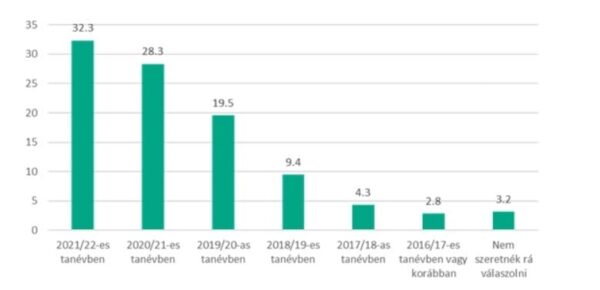
As illustrated in Figure 1, most respondents (32.3 percent) started their studies in the academic year 2021/22.
Figure 1. When did you start your university studies? % (n = 1704)
A third of the respondents were studying economics, but the response rate was also high among students in engineering and IT (13.8 per cent for the former and 10.3 per cent for the latter).
Nearly 92% of respondents are studying full-time, 82% with public scholarships. Most respondents are in bachelor’s degree programmes (74.3 per cent), but there were also respondents in undivided master’s degree programmes (10.3 per cent) and master’s degree programmes (7.7 per cent).
Why does a subject or course become a favourite? To learn to learn
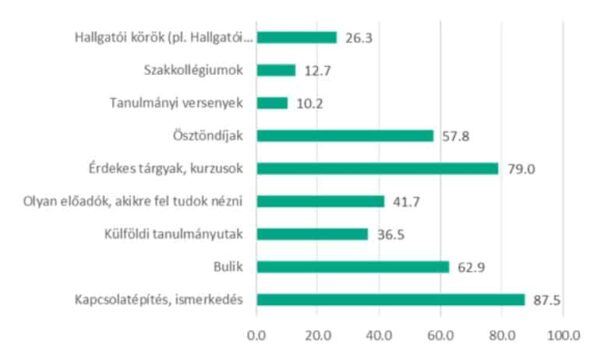
Our questionnaire also asked respondents what they like best about university life (Figure 2). Unsurprisingly, most respondents cited networking and getting to know other people – 87% of respondents think this is one of the greatest benefits of university life. Slightly behind this proportion, but compared to the rest, the opportunity to attend interesting courses and subjects during their university years is also important to many.
Respondents’ favourite subjects cover a very broad spectrum, but it is more interesting to look at why they consider a particular subject to be a favourite than to review these. The analysis of the responses shows that it is the practical orientation of the subjects and courses, as well as the preparedness of the teacher, the instructor and, in many cases, the personality of the teacher, that make a subject or course likeable. Of course, the importance of the students’ interests is also very evident.
Where and how do you prefer to learn? The conditions of learning
With our questionnaire, we also wanted to find out what kind of environment and what kind of methods you prefer to learn in, or how you learn most effectively. The most popular learning environment turned out to be your own room (respondents think this is almost entirely true for them).
This is significantly behind the library or a room on campus specifically designed for learning. The lowest rating was given to the dormitory study room – students even prefer to study in cafés and restaurants (at least according to our data) rather than in dormitory study rooms.
How much do you study per week?
We also looked at how much time fillers usually spend studying and preparing in a week. Most people (28 percent) spend 3-5 hours or 5-10 hours (26 percent) studying or preparing in a week, and about 16-16 percent spend less than 3 hours or 10-15 hours. Again, the proportion of people who study for more than 15 hours a week is the lowest (13 percent). This section also shows how the time spent studying varies by field of study.
What do you want after graduation? Programmes, jobs, career opportunities
Setting career goals is not easy. In the questionnaire, we have included questions to help you outline your ideas for the future. So we also tried to find out how you choose your path and what helps you make that choice.
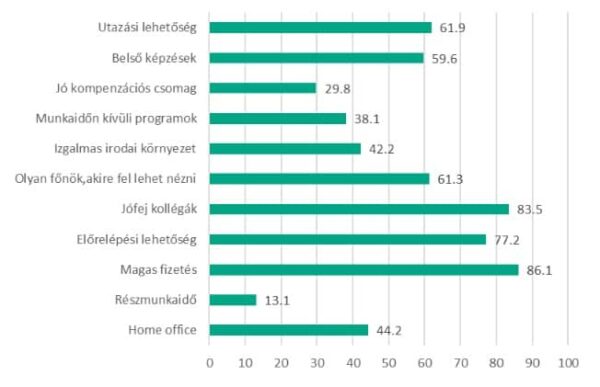
We asked you what kind of working conditions you would like to have after graduation – this is illustrated in Figure 2. Unsurprisingly, high pay was found to be the most motivating factor – 86 percent of respondents think so. In addition, the quality of the community, how „cool” colleagues are, and whether there are opportunities for career advancement also appear to be of outstanding importance.
Medium factors include whether the employer provides travel opportunities, whether the boss is someone to look up to and whether internal training is provided. The possibility of part-time work and good compensation packages were less prominent in the responses.
Entrepreneurship as an opportunity!
We also asked respondents to what extent they feel that their studies have given them the skills they need in order to be able start and run a business.
This question was answered by 870 respondents on a five-point scale, with an average of 2.68. However, there is a significant difference when looking at this question by field of study. Students/graduatesin economics, law and agriculture are the most likely to feel that they have acquired the skills needed to start and run a business during their studies, while students/graduates in humanities, medicine and health and teacher education are the least likely to think so.
How do you make a decision when you go to university?
In our questionnaire, we also wanted to find out what people choose to study at a higher education institution after secondary school. Young people make this decision mostly on the basis of information about the institution, but they also take into account the location of the university, the expected salary after graduation and their own academic performance.
The advice of friends and teachers has the least influence on this decision. The information they need to make their decision is most often found on university websites, at open days or on the institutions’ social media platforms.
42% of respondents said they found it difficult to prepare for their school-leaving exams. We also asked what they did to pass the exam and gain extra points: most (almost 69%) passed a language test, but there was also a high proportion of respondents who used an online platform to prepare (51%), went to a private tutor (49%) or attended a preparation course at school (42%).
That’s what young people studying abroad think of their life prospects
At present, approximately 20,000 young Hungarians are studying abroad, that is about 8% of all young people between 18 and 25. Of these, 88% identify as upper middle or middle class, and only a quarter of them say they will definitely return to Hungary after finishing their studies.
They say that compared to the starting monthly salary of HUF 510,000 net they expect to earn were they to return to Hungary — as opposed to those studying in Hungary, who expect only around HUF 330,000 net monthly —, abroad they will be able to earn more than double, the equivalent of HUF 1.1 million. They also calculate that amount will increase to HUF 2.5 million per month once they reach five years of work experience.
Most students are not counting on receiving a state pension, with 70% thinking the current system will be a thing of the past by the time they reach pension age.
One in two students says they already have a long-term strategy for providing for themselves.
22 percent already have some investments, of small or moderate amounts.
Of those who consider themselves to be upper or upper-middle class, 22% would never want to resort to taking out loans, while among middle and lower-middle class students, that ratio is 14%.
UNIside webshop
Hírlevél
Iratkozz fel hírlevelünkre!
Minden héten válogatott tartalmainak kapod meg, hogy naprakészek lehess oktatási, egyetemi, innovációs témákban.
Feliratkozás hírlevélre
Weboldalunk működtetése során a felhasználói élmény növeléséhez, illetve a jobb kiszolgálás érdekében oldalunk “cookie”-kat használ.
This website uses cookies to improve your experience while you navigate through the website. Out of these, the cookies that are categorized as necessary are stored on your browser as they are essential for the working of basic functionalities of the website. We also use third-party cookies that help us analyze and understand how you use this website. These cookies will be stored in your browser only with your consent. You also have the option to opt-out of these cookies. But opting out of some of these cookies may affect your browsing experience.
Necessary cookies are absolutely essential for the website to function properly. These cookies ensure basic functionalities and security features of the website, anonymously.
Cookie
Duration
Description
cookielawinfo-checkbox-advertisement
1 year
Set by the GDPR Cookie Consent plugin, this cookie is used to record the user consent for the cookies in the "Advertisement" category .
cookielawinfo-checkbox-analytics
11 months
This cookie is set by GDPR Cookie Consent plugin. The cookie is used to store the user consent for the cookies in the category "Analytics".
cookielawinfo-checkbox-functional
11 months
The cookie is set by GDPR cookie consent to record the user consent for the cookies in the category "Functional".
cookielawinfo-checkbox-necessary
11 months
This cookie is set by GDPR Cookie Consent plugin. The cookies is used to store the user consent for the cookies in the category "Necessary".
cookielawinfo-checkbox-others
11 months
This cookie is set by GDPR Cookie Consent plugin. The cookie is used to store the user consent for the cookies in the category "Other.
cookielawinfo-checkbox-performance
11 months
This cookie is set by GDPR Cookie Consent plugin. The cookie is used to store the user consent for the cookies in the category "Performance".
CookieLawInfoConsent
1 year
Records the default button state of the corresponding category & the status of CCPA. It works only in coordination with the primary cookie.
viewed_cookie_policy
11 months
The cookie is set by the GDPR Cookie Consent plugin and is used to store whether or not user has consented to the use of cookies. It does not store any personal data.
Functional cookies help to perform certain functionalities like sharing the content of the website on social media platforms, collect feedbacks, and other third-party features.
Performance cookies are used to understand and analyze the key performance indexes of the website which helps in delivering a better user experience for the visitors.
Analytical cookies are used to understand how visitors interact with the website. These cookies help provide information on metrics the number of visitors, bounce rate, traffic source, etc.
Cookie
Duration
Description
_ga
1 year 1 month 4 days
The _ga cookie, installed by Google Analytics, calculates visitor, session and campaign data and also keeps track of site usage for the site's analytics report. The cookie stores information anonymously and assigns a randomly generated number to recognize unique visitors.
_ga_*
1 year 1 month 4 days
This cookie is installed by Google Analytics.
_gat_gtag_UA_*
1 minute
Set by Google to distinguish users.
_gid
1 day
Installed by Google Analytics, _gid cookie stores information on how visitors use a website, while also creating an analytics report of the website's performance. Some of the data that are collected include the number of visitors, their source, and the pages they visit anonymously.
CONSENT
2 years
YouTube sets this cookie via embedded youtube-videos and registers anonymous statistical data.
Advertisement cookies are used to provide visitors with relevant ads and marketing campaigns. These cookies track visitors across websites and collect information to provide customized ads.
Cookie
Duration
Description
VISITOR_INFO1_LIVE
5 months 27 days
A cookie set by YouTube to measure bandwidth that determines whether the user gets the new or old player interface.
YSC
session
YSC cookie is set by Youtube and is used to track the views of embedded videos on Youtube pages.
yt-remote-connected-devices
never
YouTube sets this cookie to store the video preferences of the user using embedded YouTube video.
yt-remote-device-id
never
YouTube sets this cookie to store the video preferences of the user using embedded YouTube video.