teacher – Diplomátszerzek

Teacher training

This article was published in the UNI 2022 summer edition.

Bachelor’s degree courses

  • infant and toddler care
  • special needs education
  • specialist teaching profession
  • pre-school teacher
  • specialised teacher training
  • teaching profession

Unbranched Master’s degree

  • unbranched teacher training course

The teacher education programme offers 6 bachelor’s degrees and one master’s degree. The highest average monthly gross salary is in

  • unbranched teacher training (HUF 262,000) and 
  • specialist teaching profession (HUF 248,000)

in 2019. Depending on the subject, those interested in the field of training can choose between several higher education institutions, including those in the capital and in rural areas.

Ranking of institutions

Average starting salary after graduation is taken as a ranking indicator.
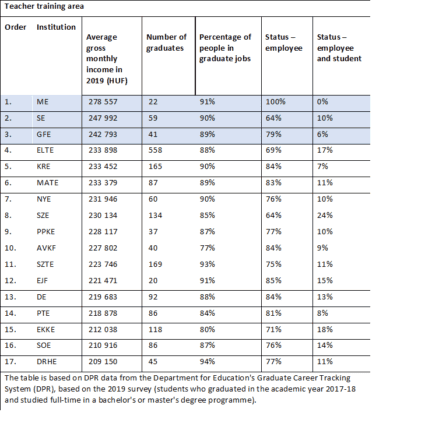
The average gross monthly income for teacher education graduates in the 2017/18 academic year (based on 2019 data) is around HUF 229,000, but there are differences between institutions. For full-time students only, the highest salaries were paid to ME graduates, who earned more than HUF 279,000 per month. In terms of average gross monthly income, SE came second with almost HUF 248,000, while GFE came third with HUF 243,000. 

88% of graduates with a bachelor’s degree in a field of study start working within 1.7 months of graduation on average. More than 88% of graduates find a graduate job.

14 % of graduates with bachelor’s degrees decide to continue their studies after graduation, the highest rates being found in the SZE (24 %), EKKE (18 %) and ELTE (17 %).

Top 3 universities

The average gross monthly income of ME graduates is close to HUF 279,000, which puts the institution at the top of our education area rankings for the expected graduate salary after graduation. The proportion of graduates in graduate jobs is high (91%) and it should be noted that ME graduates typically do not continue their studies after graduation.

The average gross monthly income of SE graduates is close to HUF 248,000, putting the university in second place in the ranking of education areas. SE also has a high proportion of graduates in graduate jobs (90%), but unlike ME, 10% of SE graduates choose to continue their studies even after they start working.

The average gross monthly income of GFE graduates is close to HUF 243,000, putting the institution in third place in the ranking of education areas. GFE students complete a bachelor’s degree in teacher education in an average of 6.7 active months. After graduation, 89% of graduates have a graduate job.

Labour market situation of graduates in teacher education

Only 7 % of teacher education graduates with a bachelor’s degree in teacher education have studied abroad (e.g. under Erasmus) during their training. During the training (before graduation), about half of the students had a professional job and 60% had a nonprofessional job. 

After graduation, a high proportion of graduates, around one third, settle and/or continue their studies in Budapest or County Pest. After completing their bachelor’s degree, also due to the nature of their studies, they tend to find a job in the public sector (68% of graduates), 16% in the private sector and around 16% in non-profit or other employment. The proportion of graduates in the field of education who are present in the labour market as employees is high (9%). Overall, graduates in teacher education are satisfied with their work (82%).


Let’s talk about self-confidence

Low self-assurance can impact people’s chances on the labour market and translate into competitive disadvantages at international level. Helping students boost their confidence is therefore crucial to assist them to overcome difficulties in everyday life and be overall happier and more successful.

This is exactly what Laura Komócsin, executive manager of Business Coach Kft. is doing, highlighting the issue through a social responsibility initiative. Laura holds free Confidence Booster workshops for students studying at university, as well as primary and secondary school level. They also developed a free app, available on their website (in Hungarian for the time being).

Photo: Pixabay

Laura’s team conducted the Hungary-wide survey on self-confidence in which respondents were asked to assess themselves in 20 areas. The lack of confidence was most evident in these:

  • 90% of students wish they received more positive feedback. Bear in mind that sometimes a nice word, a positive comment can make wonders. It doesn’t cost anything. All you need to do is pay a little attention, and the young person will grow in self-assurance in front of your eyes, while their relationship with you, the grown-up, will also improve, whether you are a parent, teacher or sports coach.
  • Interestingly, the survey showed the greatest difference in that students are taking decisions slower (scoring 3.58 on a scale of 1 to 5, compared to the average 2.53). However, this might not reflect reality, as respondents factored in not only their own assessment of themselves, but the external expectations as well.
  • The survey highlighted the fact that students are less likely to ask questions or share their knowledge with others out of a fear of strong competition and rivalry. Students should be aware that knowledge is gained by listening to teachers’ explanations, asking questions, practicing, and an even higher level of understanding is reflected in their ability to explain things to their peers.
  • Almost three quarters of students try to behave as they are expected. For them, it is important to proactively seek clarification on what those expectations are, and to be assertive and say no to tasks they consider they should not be doing — including fulfilling their parents’ dreams.
  • The survey also made it clear that two students out of three rely greatly on their existing relationships and will do anything and everything to keep these going. They are shy in new company, which explains why they stay in the same school despite their school results, even when they could swap easily to a more performing school or apply to study in higher education. In this regard, the role of parents is paramount, and if there is an emerging negative pattern, it might be worth talking to a psychologist.


Laura and her colleagues have plans to extend the survey to foreign students as well, for better understanding the results in an international context. Other plans include more workshops to school-aged children, especially to those about to finish and embark on their higher education journey.

Tips to learn from the best teacher

First steps

You can enroll in three types of courses at a Hungarian university.

  • core course
  • required course and
  • elective course.

For all three types, it is worth enquiring in advance which teacher’s course you should take. For core courses ask someone who has been studying the same major as you. It occures especially for courses at the first semester that they are being tought at several majors at the same time, but still it’s better to make sure.

Turn to your mentor!

If you’ve been to a freshman camp or an immersion week, then firstly it’s a good choice to turn to your mentor you met there. Even if you’re not studying the same major, he or she must have heard something of the teacher, or may know someone whom you could be referred to.  

Ask students with more experience!

Is there a more credible source than students who have spent at least one semester in the classes of the tutor in question? Where can you find them? 

Key of the solution is the often mentioned Facebook groups. There must be a group of same major students or of all students, which has a lot of members regardless of major or year of study. All you need to do is post a question: „Could you share some experiences on class Y of teacher X, please” or „Could anyone say a few words of Mrs., Mr., Ms. XY, please?”. The answer will sure be there within an hour.

Head to Markmyprofessor!

Not only teachers can rate students’ performance on a five-point scale, but vice versa. Markmyprofessor is a website developed in Hungary and on this site students can rate teachers in higher education. It’s very simple to use: type the teacher’s name into the search bar, then see the score of the particular teacher and then you may scrutinize the comments as well. 

Important though: anyone can rate anyone on Markmyprofessor, the system does not cross-check it whether the person providing information has been taught by the particular teacher, or not.

Listen to your heart!

Remember, no two people on earth are alike! It’s up to each individual what presentation and teaching style he or she likes. 

Weigh in your information you collected and then ask yourself: is the teacher they’ve recommended the right one for me? The decision and the responsibility are yours only.

As in all aspects of life, you will become more and more experienced in this regard as time passing by. However, don’t be discouraged, the world will not fall apart, if you don’t manage to enroll to the course of the teacher you had your eyes on. You could always try next semester again.